school readiness checklist for preschoolers
School Readiness Checklist Without Pressure for Preschoolers
Use this school readiness checklist for preschoolers to build routines, language, independence, social skills, early literacy, numeracy, and confidence without pressure.
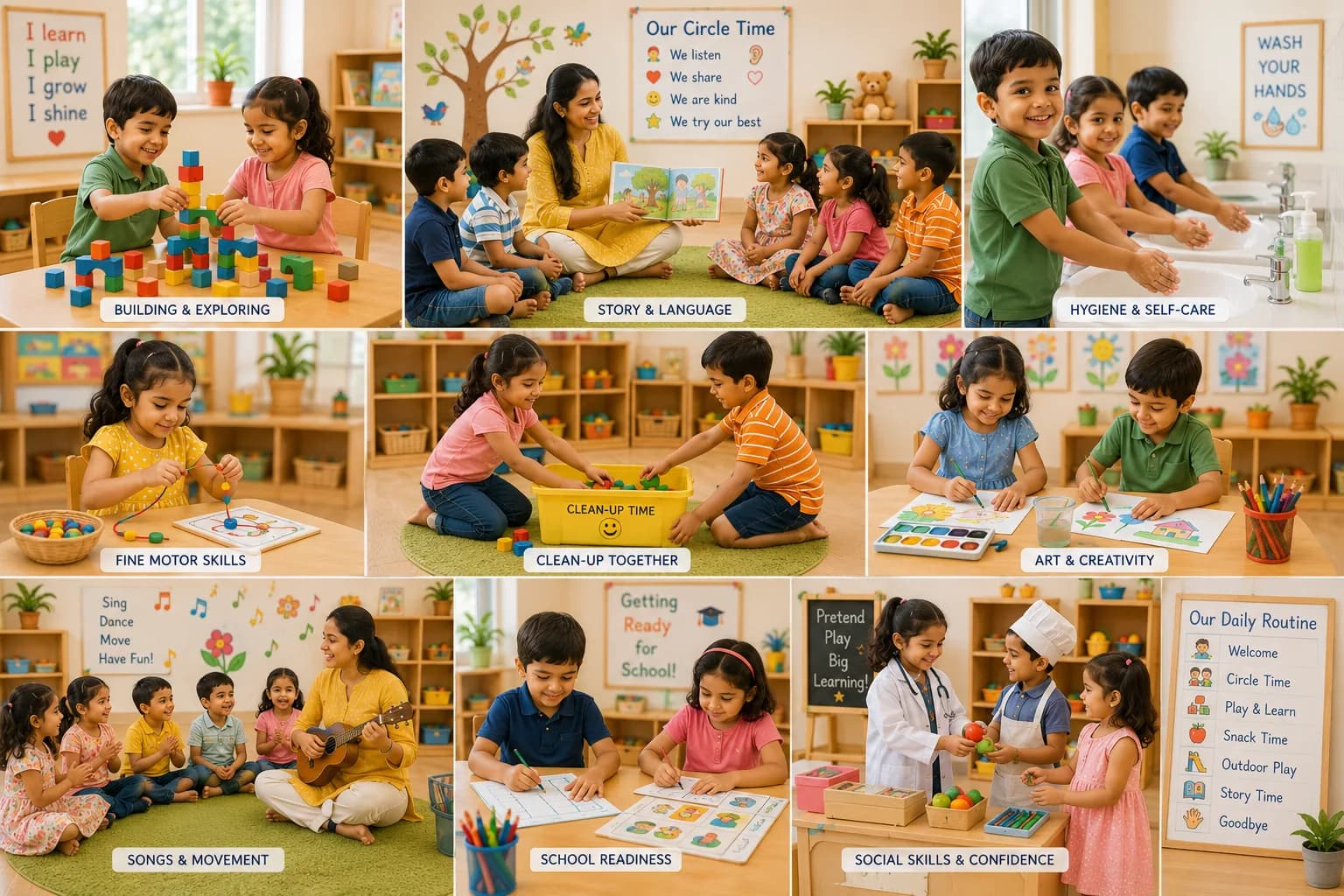
School readiness is not only about worksheets. Preschool children need routines, confidence, communication, independence, social comfort, and caring guidance.
What is a school readiness checklist for preschoolers?
A school readiness checklist for preschoolers helps parents understand whether a child is gradually building the routines, communication, independence, social comfort, fine motor skills, early literacy, early numeracy, and emotional confidence needed for the next stage. School readiness without pressure means preparing children through play, stories, conversations, routines, self-help habits, observation, and caring teacher guidance instead of rushing them into heavy worksheets or stressful expectations. For parents searching for preschool readiness near Nallagandla, Hyderabad, it is important to remember that readiness is not only about ABC, numbers, reading, or writing. At Kaizen Preschool in Nallagandla, school readiness grows through play-based learning, daily routines, parent partnership, and age-appropriate activities.
School readiness checklist for parents
Parents can use a simple school readiness checklist to understand whether the child is gradually becoming comfortable with routines, communication, independence, and group learning.
- Can the child separate from parents gradually with support?
- Can the child follow simple one-step or two-step instructions?
- Can the child express basic needs such as water, food, toilet, help, or discomfort?
- Can the child sit for a short story, rhyme, or group activity?
- Can the child try small self-help routines such as washing hands, carrying a bag, or opening a snack box?
- Can the child wait briefly for a turn with teacher support?
- Can the child hold crayons, use clay, stack blocks, tear paper, or complete simple hand tasks?
- Can the child participate in songs, stories, pretend play, movement, and classroom activities?
- Can the child slowly adjust to classroom routines such as arrival, snack time, clean-up, and dispersal?
A checklist is a guide, not a test
A school readiness checklist should help parents observe the child with care. It should not become a pressure tool or a comparison between children.
Readiness grows slowly
Children may be strong in some areas and still need support in others. A child may speak well but need help with routines, or enjoy play but need more time for separation.
Readiness begins with comfort
Children learn better when they feel emotionally settled. A warm preschool rhythm helps them separate gradually, participate in group life, and trust the classroom routine.
- Emotional comfort helps children feel safe enough to explore, listen, speak, and participate.
- A child who feels secure is more likely to join circle time, play with peers, and try new activities.
- Separation from parents may take time, especially for playgroup and nursery children.
- Warm teacher interaction helps children slowly build trust in the classroom.
- Predictable routines reduce confusion and support classroom confidence.
- Emotional readiness for preschool is an important part of school readiness.
- School readiness without pressure begins by helping the child feel safe, seen, and supported.
Why emotional readiness matters
A young child cannot learn well if they feel scared, rushed, or constantly corrected. Comfort, attachment, routine, and teacher warmth create the foundation for meaningful learning.
Settling is part of readiness
Some children settle quickly, while others need more time. Gradual adjustment, familiar routines, songs, stories, peer play, and calm teachers help children enter school life with confidence.
Language matters every day
Listening, naming, storytelling, rhymes, conversations, and simple questions all help children express needs and ideas before formal academics become heavier.
- Listening to stories helps children build attention, memory, vocabulary, and imagination.
- Rhymes and songs support sound awareness, pronunciation, rhythm, and early literacy readiness.
- Picture talk helps children name objects, actions, colors, people, places, and feelings.
- Simple questions help children think, respond, and express ideas.
- Children need confidence to ask for help, share needs, and speak in group settings.
- Language development for school readiness grows through daily conversation and repetition.
- Speaking and listening skills are important readiness skills for preschoolers.
Language comes before writing
Before children write confidently, they need to listen, understand, speak, describe, retell, and use words in daily situations. Strong oral language supports later reading and writing.
Parents can support language at home
Parents can talk during meals, bath time, dressing, travel, story time, and play. Simple questions like 'What happened?', 'What do you see?', and 'What comes next?' support language growth.
Routines build confidence
Arrival, snack time, clean-up, circle time, activity time, outdoor play, and rest all teach children how a school day works in a calm and predictable way.
- Arrival routines help children transition from home to school.
- Circle time helps children listen, sit in a group, sing, respond, and participate.
- Snack and lunch routines build independence, hygiene, patience, and self-help skills.
- Clean-up routines teach responsibility and care for shared materials.
- Outdoor play and movement routines help children release energy and build body confidence.
- Rest and quiet time help children regulate energy and emotions.
- Positive preschool routines help children understand expectations without pressure.
Predictability reduces stress
Young children feel calmer when they know what comes next. A predictable routine helps them participate with less resistance and more confidence.
Routines teach school behavior naturally
Waiting for a turn, washing hands, carrying a bag, keeping materials back, sitting in a group, and following simple instructions are important classroom readiness skills.
Independence grows slowly
Small responsibilities such as carrying a bag, caring for materials, washing hands, waiting for a turn, and completing simple tasks support school readiness.
- Carrying a school bag builds responsibility and routine awareness.
- Washing hands supports hygiene and self-help skills.
- Eating with less help supports independence and confidence.
- Putting toys and materials back supports responsibility.
- Waiting for a turn supports patience and group participation.
- Completing small tasks builds focus, effort, and confidence.
- Self-help skills for preschoolers are an important part of school readiness.
Do not expect independence overnight
Children need repeated practice to become independent. Adults can support them by giving small responsibilities and encouraging effort instead of doing everything for them.
Small tasks create big confidence
When a child learns to open a snack box, keep shoes in place, carry a bottle, or clean up toys, they slowly develop confidence and readiness for school routines.
Fine motor skills support writing readiness
Before children write neatly, they need finger strength, hand control, eye-hand coordination, sitting posture, and confidence with tools.
- Clay play strengthens fingers and hands.
- Tearing, pasting, threading, stacking, and sorting support fine motor control.
- Coloring and drawing help children practice grip, direction, and hand movement.
- Puzzles and blocks support eye-hand coordination and problem-solving.
- Pouring, spooning, and arranging materials build control and independence.
- Writing readiness grows through hands-on activities before formal writing practice.
- Fine motor skills for school readiness should be built gradually and playfully.
Writing begins before pencil work
Children need hand strength, shoulder control, wrist movement, finger coordination, and visual tracking before they can write comfortably.
Avoid rushing writing
Heavy writing too early can create pressure. Drawing, clay, puzzles, beads, blocks, and practical self-help tasks prepare the hand in a more natural way.
Early literacy and numeracy should be age-appropriate
School readiness includes early exposure to sounds, stories, books, letters, numbers, sorting, matching, counting, and patterns in a playful way.
- Early literacy begins with listening, speaking, rhymes, stories, picture books, and vocabulary.
- Children can notice letters and sounds through songs, names, labels, and picture talk.
- Early numeracy begins with counting real objects, sorting, matching, comparing, and pattern play.
- Number sense grows better when children touch, move, group, and count real items.
- Worksheets should not replace stories, play, conversation, and hands-on learning.
- School readiness activities should match age and development stage.
- Preschool learning without pressure helps children stay curious and confident.
Concepts before memorization
Children understand better when they experience ideas. Counting beads, sorting leaves, matching colors, and listening to stories help build foundations before formal academic work.
Readiness is gradual
Some children recognize letters early, some speak more confidently first, and some show strength in movement, art, or social play. Readiness grows across many areas.
Social skills are part of school readiness
A child who can share, wait, ask, listen, help, and play with others is building important classroom readiness skills.
- Sharing helps children understand cooperation and patience.
- Waiting for a turn supports group participation.
- Asking for help builds communication and confidence.
- Listening to others supports classroom behavior and social comfort.
- Helping friends builds kindness and responsibility.
- Solving small conflicts with teacher guidance builds emotional maturity.
- Social skills for school readiness grow through guided play and daily routines.
Group life needs practice
Preschool may be the first place where a child regularly shares space, toys, teachers, and routines with other children. Social readiness grows slowly through real group experiences.
Play teaches social behavior
Group games, pretend play, block play, outdoor play, and clean-up time naturally create opportunities to practice waiting, sharing, speaking, and helping.
School readiness by age group
Readiness expectations should match the child's age, program level, emotional comfort, language confidence, and independence.
- For playgroup children aged 2 to 3 years, readiness includes settling, simple routines, naming, movement, sensory play, basic self-help, and comfort with teachers.
- For nursery children aged 3 to 4 years, readiness includes listening, rhymes, pretend play, sorting, sharing, hand control, and following simple instructions.
- For PP1 children aged 4 to 5 years, readiness includes storytelling, early concepts, group participation, fine motor tasks, independence, and confidence.
- For PP2 children aged 5 to 6 years, readiness includes stronger listening, early literacy, early numeracy, social confidence, self-help, and readiness for the next stage.
- School readiness for 3 year olds should focus more on comfort, routine, language, and play.
- School readiness for 4 year olds can include more structured activities, stories, counting, and group work.
- School readiness for 5 year olds can include early writing readiness, classroom participation, and longer attention.
Readiness should not be compared
Children grow at different speeds. A readiness approach should observe each child's progress instead of comparing children with one another.
Each stage has different goals
Playgroup, nursery, PP1, and PP2 should not look the same. As children grow, expectations can slowly increase in language, routines, independence, early concepts, and participation.
PP1, PP2, LKG, and UKG readiness
Parents in Hyderabad often search for LKG readiness or UKG readiness, while some preschools use PP1 and PP2 program names.
- PP1 readiness often includes stronger routines, vocabulary, storytelling, early concepts, fine motor tasks, and group participation.
- PP2 readiness can include stronger listening, early literacy, early numeracy, classroom confidence, self-help, and readiness for the next formal stage.
- LKG readiness searches usually focus on whether the child can follow routines, communicate needs, sit for short learning time, and participate in classroom activities.
- UKG readiness searches often focus on early literacy, number sense, writing readiness, social confidence, and independence.
- The exact program names may differ across schools, so parents should ask what each level includes.
- Readiness should be understood by observing the child, not only by age or worksheets.
- Parents should ask the preschool how PP1, PP2, LKG, or UKG readiness is supported in an age-appropriate way.
Use program names carefully
Different schools may use different names such as PP1, PP2, LKG, or UKG. Parents should understand the actual skills, routines, and learning goals behind each program name.
Readiness is not only academics
Whether the program is called PP1, PP2, LKG, or UKG, children also need confidence, communication, social comfort, independence, and classroom habits.
What school readiness is not
School readiness should not become pressure-heavy learning or constant comparison between children.
- School readiness is not forcing children to write before their hands are ready.
- It is not expecting every child to sit still for long periods.
- It is not comparing one child's progress with another child's progress.
- It is not only daily worksheets, memorization, or early academic drilling.
- It is not expecting perfect pronunciation, perfect coloring, or perfect behavior.
- It is not rushing children into reading and writing before they are developmentally ready.
- School readiness should protect curiosity, confidence, and joy.
Pressure can reduce confidence
When young children feel constantly judged or rushed, they may avoid trying. A calm readiness approach helps children build effort, confidence, and willingness to learn.
Balanced readiness works better
Children need play, movement, stories, routines, social interaction, self-help, early concepts, and teacher guidance for balanced school readiness.
Signs your child may need more time
Needing more time does not mean failure. It simply means the child may need extra support with comfort, routines, language, or independence.
- The child shows frequent distress during separation even after gentle support.
- The child finds it difficult to express basic needs such as water, food, toilet, help, or discomfort.
- The child strongly resists simple routines such as sitting briefly, cleaning up, or following instructions.
- The child feels tired, overwhelmed, or withdrawn during group activity.
- The child needs more help with self-care routines such as eating, toilet routine, or handwashing.
- The child avoids joining play or interaction with teachers and peers.
- The child may need more gradual exposure, home support, teacher guidance, and routine practice.
Support matters more than pressure
If a child is not ready in one area, parents and teachers can support the child through routines, play, language practice, emotional comfort, and patient repetition.
Every child grows differently
Some children need extra time for language, some for independence, some for social comfort, and some for classroom routines. Observation helps adults respond better.
Progress should be observed
Observation-based progress helps teachers and parents understand growth in habits, communication, social comfort, and learning readiness without rushing the child.
- Teachers can observe how children participate in routines and activities.
- Language progress can be seen in listening, naming, asking, responding, and storytelling.
- Social progress can be seen in sharing, waiting, helping, and playing with peers.
- Independence can be seen in self-help routines and small responsibilities.
- Fine motor progress can be seen in drawing, clay work, puzzles, stacking, and tool use.
- Emotional progress can be seen in settling, confidence, and willingness to try.
- Preschool progress without comparison helps children grow with confidence.
Observation is better than pressure
Young children should not be judged only by worksheets or written output. Observation gives a fuller picture of how the child is growing across many areas.
Parents and teachers should discuss progress
Parent partnership helps when teachers share observations and parents share home routines, concerns, strengths, and changes in the child's behavior.
Parents can support school readiness at home
School readiness grows faster when home and school gently support similar routines, language, independence, and confidence.
- Create a simple morning routine for waking up, brushing, dressing, breakfast, and school bag preparation.
- Read picture books and talk about characters, colors, actions, and feelings.
- Give small responsibilities such as keeping toys back, carrying a bottle, or arranging shoes.
- Practice polite words, waiting, sharing, and asking for help.
- Encourage drawing, clay play, puzzles, blocks, and sorting for fine motor development.
- Allow outdoor play, movement, balancing, jumping, and ball play.
- Avoid turning every activity into a test or comparison.
Home routines matter
Sleep, food, play, hygiene, screen-time boundaries, story time, and morning routines all affect how ready a child feels for school.
Encourage effort, not perfection
Parents can praise small efforts such as trying again, sharing, waiting, cleaning up, speaking clearly, or completing a small task.
What parents should ask during a preschool visit
Parents looking for school readiness preschool options can ask clear questions during a school visit.
- How does the preschool build school readiness without pressure?
- How are language, early literacy, and early numeracy introduced?
- How does the school support routines, self-help, and independence?
- How are social skills such as sharing, waiting, and group participation supported?
- How is progress observed and shared with parents?
- How does readiness differ for playgroup, nursery, PP1, and PP2?
- How does the school balance play, routines, creativity, movement, and early academics?
Look beyond worksheets
During a school visit, parents can observe whether children are speaking, moving, playing, listening, sharing, exploring, and receiving teacher guidance.
Ask about readiness indicators
Parents can ask what signs teachers observe before saying a child is ready for the next stage. These may include confidence, language, independence, social comfort, routines, and early concepts.
School readiness near Nallagandla
Parents near Nallagandla and nearby areas often look for a preschool that prepares children for the next stage while protecting the joy of early childhood.
- Parents in Nallagandla may look for a preschool that balances routines, language, play, values, and readiness.
- Families from Serilingampalle, Tellapur, Gopanpally, Lingampally, Gachibowli, Financial District, Nanakramguda, and Kokapet may consider travel time, daycare needs, and daily schedule.
- A good readiness approach should be age-appropriate and child-friendly.
- Parents can observe whether the school uses play-based learning and caring teacher guidance.
- Parents can ask how school readiness is supported in playgroup, nursery, PP1, and PP2.
- Local convenience matters because young children need a manageable daily routine.
- School readiness preschool near me searches should lead parents to ask about comfort, communication, independence, routines, and readiness.
Choose readiness with balance
For young children, readiness should not mean pressure-heavy academics. It should include confidence, curiosity, communication, independence, play, values, and emotional comfort.
Visit before deciding
A school visit helps parents understand how readiness is actually built through daily routines, classroom activities, teacher guidance, and parent communication.
How Kaizen Preschool supports school readiness without pressure
At Kaizen Preschool, school readiness is supported through routines, play-based learning, language, values, independence, movement, creativity, and caring teacher guidance.
- Children are supported through age-appropriate routines and classroom rhythms.
- Teachers guide language, listening, speaking, storytelling, and expression.
- Play-based activities support thinking, creativity, problem-solving, and social skills.
- Fine motor activities support hand control and writing readiness.
- Children are encouraged to build independence through small daily responsibilities.
- Progress is understood through observation, participation, habits, and confidence.
- School readiness is built gradually without pressure-heavy expectations.
A readiness-focused preschool in Nallagandla
For parents searching for preschool readiness in Nallagandla, Serilingampalle, Tellapur, Gopanpally, Lingampally, Gachibowli, Financial District, Nanakramguda, or Kokapet, Kaizen Preschool offers a warm, practical approach where routines, play, language, values, and readiness grow together.
Ready for school, without losing joy
The goal is to help children become confident, independent, communicative, curious, and ready for the next stage while still enjoying childhood.
School readiness grows best without pressure
School readiness is not only about worksheets, writing, reading, or numbers. Young children also need emotional comfort, routines, language confidence, independence, social skills, fine motor control, early thinking, and caring adult guidance. When readiness is built through play, stories, conversations, routines, observation, parent partnership, and age-appropriate activities, children become more confident for the next stage without losing the joy of childhood. For parents near Nallagandla, Hyderabad, Kaizen Preschool supports school readiness without pressure through balanced early learning, warm routines, and purposeful guidance.
FAQs
Common parent questions
What is a school readiness checklist for preschoolers?
A school readiness checklist helps parents look at routines, communication, independence, social comfort, fine motor skills, early literacy, early numeracy, and emotional readiness before the next stage.
What is school readiness in preschool?
School readiness means a child is gradually building the confidence, routines, communication, independence, social skills, fine motor skills, early literacy, early numeracy, and emotional comfort needed for the next stage of learning.
What does school readiness without pressure mean?
School readiness without pressure means preparing children through play, routines, language, self-help, social skills, creativity, and caring guidance instead of rushing them into heavy worksheets or stressful expectations.
How do I know if my child is ready for school?
A child may be ready when they can separate gradually, follow simple routines, express basic needs, listen for short periods, participate in play, try self-help tasks, and interact with teachers and peers.
What if my child is not ready for school?
If a child needs more time, it does not mean failure. Parents and teachers can support the child through routines, language, play, independence practice, and emotional comfort.
Is school readiness only about reading and writing?
No. Reading and writing readiness are only one part. Children also need listening, speaking, independence, confidence, fine motor control, social comfort, routine awareness, and emotional security.
How can I prepare my child for preschool?
Parents can prepare a child for preschool through simple routines, story time, self-help habits, toilet routines, sharing, waiting, naming objects, outdoor play, and gentle conversations about school.
How do I prepare my child for LKG?
Parents can prepare a child for LKG through storytelling, simple routines, self-help habits, fine motor play, early counting, picture talk, social play, and confidence-building activities.
What are important school readiness skills for preschoolers?
Important school readiness skills include listening, speaking, following simple instructions, asking for help, sharing, waiting, using hands for tasks, participating in groups, and managing basic self-help routines.
What are good school readiness activities at home?
Good activities include picture book reading, storytelling, sorting objects, counting real items, clay play, drawing, puzzles, blocks, pretend play, outdoor movement, clean-up routines, and simple helper tasks.
Is early writing necessary for school readiness?
Early writing should grow gradually. Before writing neatly, children need hand strength, finger control, drawing, coloring, clay play, puzzles, and confidence with tools.
How does play support school readiness?
Play supports school readiness by building language, social skills, problem-solving, creativity, fine motor control, movement, confidence, patience, and group participation.
How do routines help school readiness?
Routines help children understand what comes next. Arrival, snack time, clean-up, circle time, rest, and dispersal routines support confidence, independence, cooperation, and classroom participation.
How do I know if my child is ready for nursery?
A child may be ready for nursery when they can begin to separate, follow simple routines, communicate needs, participate in play, listen to short instructions, and engage with teachers and peers.
How do I know if my child is ready for PP1 or PP2?
For PP1 and PP2, readiness includes stronger language, group participation, self-help habits, fine motor control, early concepts, social comfort, and ability to follow classroom routines.
Should preschool children do worksheets every day?
Worksheets may have limited use at the right age, but young children need more hands-on play, stories, conversation, movement, art, routines, and real experiences for balanced development.
What should parents ask about school readiness during a preschool visit?
Parents can ask how the preschool supports language, routines, independence, social skills, fine motor development, early literacy, early numeracy, progress observation, and readiness without pressure.
What should I look for in a school readiness preschool near Nallagandla?
Parents can look for warm teacher guidance, predictable routines, play-based learning, language development, independence support, social comfort, parent communication, and age-appropriate readiness activities.
How does Kaizen Preschool support school readiness?
Kaizen Preschool supports school readiness through routines, play-based learning, stories, songs, language development, fine motor activities, self-help habits, social skills, observation, and caring teacher guidance.
Next steps
Helpful next steps
Continue with these related pages before booking a school visit or admission conversation.
Want to discuss your child's next step?
Book a school visit, call, or WhatsApp Kaizen Preschool to understand programs, daycare, admissions, and readiness support in Nallagandla.