preschool visit checklist in Nallagandla
Preschool Visit Checklist: Questions to Ask Before Admission
Use this preschool visit checklist to ask about routines, learning, communication, admissions, daycare, and child comfort before choosing a school.
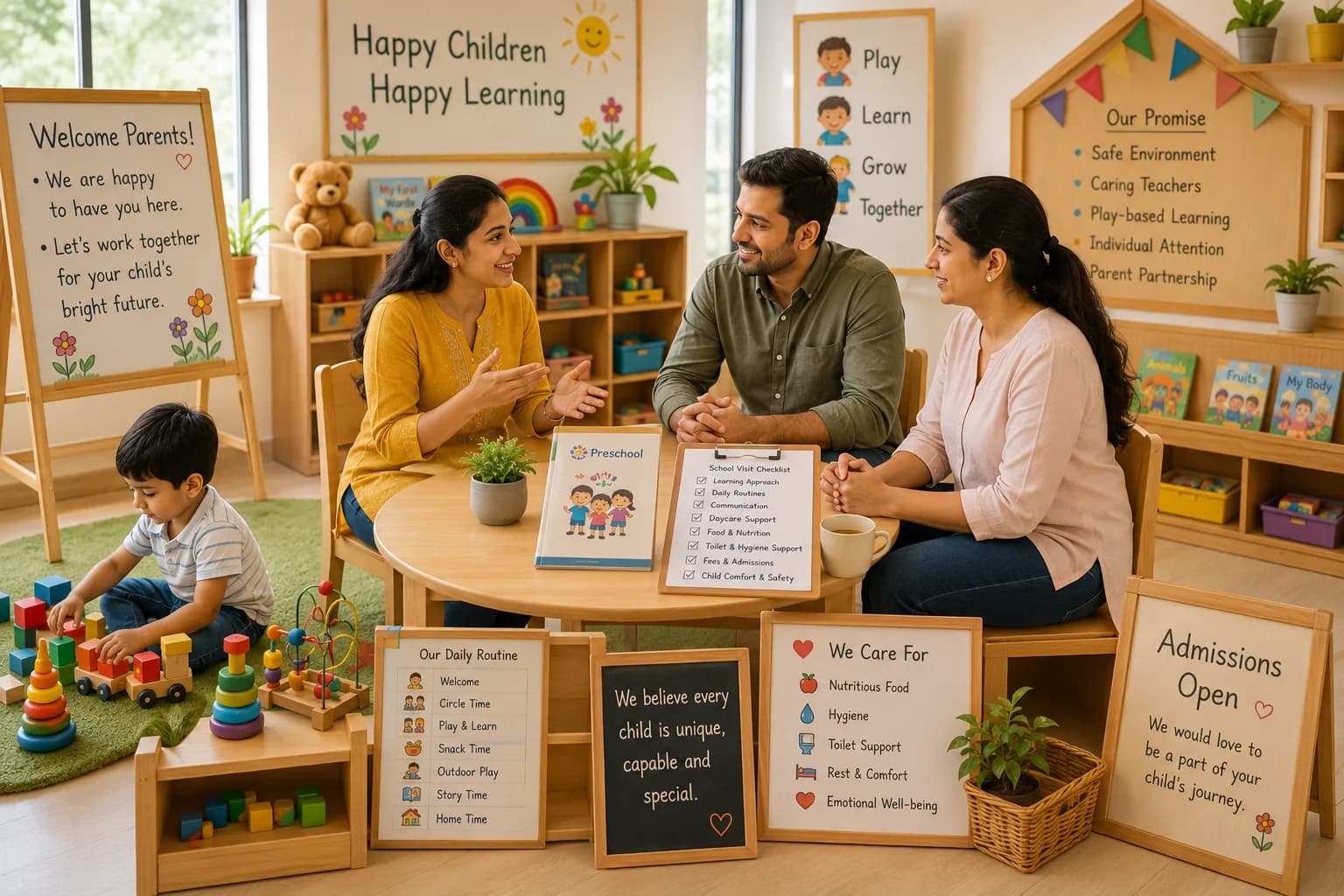
Before preschool admission, parents should ask the right questions about routines, teachers, learning approach, fees, daycare, safety, food, communication, and child comfort.
Why parents need a preschool visit checklist
Choosing a preschool is one of the first important education decisions for a young child. A preschool visit becomes more useful when parents know what to ask, what to observe, and how to understand whether the environment feels warm, age-appropriate, and practical for their child. For parents searching for preschool admission in Nallagandla, Hyderabad, or nearby areas like Serilingampalle, Tellapur, Gopanpally, Lingampally, Gachibowli, Financial District, Nanakramguda, and Kokapet, this preschool visit checklist can help compare routines, teacher interaction, learning approach, daycare support, fees, safety, parent communication, child comfort, and admission steps with more clarity.
Ask about the daily rhythm
Parents can ask how the day is divided between play, group time, stories, movement, meals, rest, outdoor activity, and teacher-guided learning.
- What does a normal preschool day look like from arrival to dispersal?
- How much time is given for play-based learning, stories, songs, movement, and creative activities?
- How are snack time, lunch time, handwashing, toilet routines, and clean-up routines managed?
- Is there a balance between active play, quiet time, group participation, and individual exploration?
- How does the school support children who need more time to settle into the daily routine?
- Are routines different for playgroup, nursery, PP1, PP2, and daycare children?
- How does the daily rhythm support independence, listening, language, social comfort, and school readiness?
Why daily routine matters
Young children feel more secure when they know what comes next. A predictable preschool daily routine helps children settle, participate, eat, play, rest, and transition from one activity to another with more confidence.
What parents should observe
During a school visit, parents can observe whether children look engaged, whether teachers guide transitions calmly, whether routines are clear, and whether the day feels balanced between play, movement, learning, and care.
Ask how children settle into preschool
It is useful to understand how the school supports separation, comfort, transitions, crying, new classroom adjustment, and early emotional security.
- How does the school help a child who cries during the first few days?
- Is there a gradual settling process for new preschool children?
- How do teachers comfort children during separation from parents?
- How are shy, quiet, active, or hesitant children supported?
- How does the school communicate with parents during the early adjustment period?
- How are transitions handled between arrival, circle time, play, meals, rest, and dispersal?
- What should parents do at home to help the child settle better?
Settling takes time
Some children settle quickly, while others need more days to feel comfortable. Parents should ask how the preschool supports this process with warmth, routine, teacher attention, peer play, and calm communication.
Child comfort is an important sign
A good school visit should help parents understand whether the child feels welcomed, whether teachers speak gently, and whether the classroom supports emotional comfort along with learning.
Ask about teacher-child interaction
Teacher interaction is one of the most important things parents should observe during a preschool visit.
- How do teachers speak to children during activities and transitions?
- Do teachers come down to the child's level while talking?
- How do teachers guide children who do not listen immediately?
- How are sharing, waiting, helping, and clean-up habits encouraged?
- Do teachers use simple words, gestures, songs, stories, and visual cues?
- How are children encouraged to ask, speak, try, and participate?
- How does the school ensure children feel respected and heard?
Observe the tone of the classroom
Parents can learn a lot by observing how teachers respond when children are confused, active, emotional, or slow to follow instructions. Calm and respectful guidance is important in the preschool years.
Teacher guidance supports learning
In preschool, teachers do not only supervise children. They guide language, habits, routines, play, values, confidence, social skills, and early school readiness.
Ask about the learning approach
A balanced preschool approach should consider language, play, movement, creativity, values, routines, confidence, and readiness.
- Is the preschool approach play-based, activity-based, worksheet-heavy, or a mix?
- How does the school support language development through stories, songs, conversation, and picture talk?
- How are early literacy and early numeracy introduced in an age-appropriate way?
- How are movement, outdoor play, fine motor skills, and creative work included?
- How does the school build values such as kindness, respect, sharing, and responsibility?
- How are children prepared for the next stage without pressure-heavy learning?
- How does the curriculum differ for playgroup, nursery, PP1, and PP2?
Ask beyond ABC and 123
Preschool learning should not be only about early academics. Parents should ask how the school supports confidence, communication, independence, habits, creativity, social skills, movement, and emotional comfort.
Look for play with purpose
A useful preschool activity should support one or more skills such as language, thinking, hand control, movement, sharing, problem-solving, observation, or self-expression.
Ask about safety, hygiene, and supervision
Parents should ask practical questions about child supervision, hygiene routines, washroom support, classroom safety, and daily care.
- How are children supervised during classroom play, outdoor play, meals, and dispersal?
- How are handwashing, toilet routines, drinking water, and clean-up habits managed?
- How does the school support younger children who still need help with washroom routines?
- What is the process if a child is unwell or uncomfortable during school hours?
- How are visitors, pickup, and dispersal handled?
- How does the school manage shared toys, classroom materials, and hygiene habits?
- What should parents pack daily for the child?
Practical care matters every day
For young children, safety and hygiene are part of daily learning. Handwashing, clean-up, toilet support, safe movement, and calm supervision help children feel secure.
Ask about real routines, not only facilities
Infrastructure is important, but parents should also ask how teachers and staff manage daily care moments such as snack time, washroom support, outdoor play, and dispersal.
Ask about fees and payment options
Preschool fee questions are important because parents should clearly understand what is included, what is separate, and what payment options are available.
- What is the admission fee or one-time enrollment fee?
- What is the annual fee or program fee for playgroup, nursery, PP1, PP2, or daycare?
- Are term-wise payment options available?
- Are books, activities, uniform, transport, meals, or daycare charges included or separate?
- Are there any important payment dates parents should know?
- What happens if parents choose daycare along with preschool?
- Whom should parents contact for fee clarification after the school visit?
Ask what is included and excluded
Parents should ask for a clear understanding of the fee structure. It is useful to know whether books, activities, uniforms, daycare, transport, meals, events, or other items are included or separate.
Keep fee discussion practical
A fee discussion should help parents plan calmly. Parents can ask about payment options, due dates, program-wise fees, daycare charges if applicable, and any documents needed for admission.
Ask about food, snacks, and lunch policy
Food routines matter for young children, especially during playgroup, nursery, daycare, and longer preschool hours.
- What is the snack time and lunch time routine?
- Should parents send snacks, lunch, water bottle, napkin, or spoon daily?
- Are children encouraged to eat independently?
- How does the school support children who eat slowly or need help?
- Are there rules about food sharing between children?
- How should parents inform the school about allergies or food restrictions?
- What food items are preferred or not preferred for preschool?
Mealtime is also a routine
Snack and lunch routines help children build independence, hygiene, patience, self-feeding habits, and social comfort. Parents should ask how these routines are managed daily.
Clear food communication helps
Parents should communicate allergies, food preferences, eating difficulties, and any important instructions clearly during admission or before the child starts school.
Ask about toilet training and washroom support
Toilet routine questions are very important for parents of toddlers, playgroup children, and nursery children.
- Does the child need to be fully toilet trained before admission?
- How does the school support children who are still learning toilet routines?
- What happens if a child has a toilet accident?
- Should parents send extra clothes daily?
- How are hygiene and handwashing managed after washroom use?
- How are parents updated if the child needs support with toilet routine?
- How does the school handle toilet routines with dignity and care?
Toilet learning takes time
Young children may still be learning toilet signals, timing, and independence. Parents should ask how the preschool supports this stage in a calm, respectful, and practical way.
Extra clothes and communication help
Parents can ask what to pack daily, how accidents are handled, and how the school communicates if the child needs more support with washroom routines.
Ask about pickup, dispersal, and emergency contact
Pickup and dispersal routines should be clear because young children need safe and predictable handover.
- Who is allowed to pick up the child?
- Is parent ID, pickup authorization, or prior information required?
- What is the process for late pickup?
- How does the school handle emergency contact situations?
- How are children supervised during dispersal time?
- Can parents update pickup details if needed?
- What should parents do if someone else needs to pick up the child?
Dispersal should be organized
A smooth dispersal routine helps children stay calm and helps parents feel confident. Parents should understand the pickup process clearly before the child starts school.
Emergency contacts should be updated
Parents should keep contact numbers, alternate pickup details, and emergency information updated so the school can respond quickly when needed.
Ask about daycare support
Parents who need extended care should ask how daycare routines support rest, meals, play, safety, and emotional comfort.
- What are the daycare timings and available options?
- How are meals, snacks, rest, quiet time, and play time handled?
- How does the daycare team support children after preschool hours?
- How are younger children comforted if they miss home?
- What should parents send for daycare?
- How does the school communicate daycare updates to parents?
- How are preschool and daycare routines connected for the child?
Daycare is more than waiting time
For working parents, daycare should feel caring, predictable, and age-appropriate. Children need rest, play, meals, supervision, and emotional comfort after preschool hours.
Check if the routine suits your child
Before choosing daycare, parents should ask whether the schedule matches the child's age, nap habits, food routine, energy level, and emotional needs.
Ask about parent communication
Parent communication can include updates about routines, habits, participation, concerns, progress, and readiness for the next stage.
- How often does the school communicate with parents?
- What kind of updates are shared about the child?
- Are parents informed about food, routine, participation, mood, and classroom activities?
- How does the school handle concerns raised by parents?
- How are child observations and progress discussed?
- Does communication focus only on complaints or also on growth and guidance?
- How can parents contact the school for admission, daycare, or routine queries?
Good communication supports trust
Parents feel more confident when they understand what is happening in school. Clear communication about routines, participation, habits, comfort, and progress helps home and school work together.
Ask how progress is observed
In preschool, progress should be observed through participation, language, social comfort, independence, habits, motor skills, creativity, and readiness, not only worksheets or marks.
Ask about programs and age suitability
Parents should understand which program suits the child's age, comfort, readiness, and family needs.
- Which program is suitable for a 2 to 3 year old child?
- What is the difference between playgroup and nursery?
- How does PP1 prepare children for PP2?
- How does PP2 support readiness for the next stage?
- Does the school offer daycare along with preschool programs?
- How does the school decide if a child is ready for a particular program?
- What should parents share about the child's habits, language, food, toilet routine, and previous school experience?
Age is important, but readiness also matters
While age guides program selection, children also differ in communication, independence, social comfort, attention, and routine habits. Parents should discuss these openly during admission enquiry.
Understand each program clearly
A preschool visit should help parents understand playgroup, nursery, PP1, PP2, and daycare options clearly before making a decision.
Ask about admission steps and documents
Before leaving the visit, parents can ask about admission steps, required documents, fee structure, program availability, and follow-up contact options.
- What is the admission process for playgroup, nursery, PP1, PP2, or daycare?
- What documents are required for preschool admission?
- Is a school visit or child interaction needed before admission?
- What are the available program timings?
- What are the payment options and important dates?
- Whom should parents contact after the visit?
- How can parents book a follow-up discussion if needed?
Keep admission questions practical
Parents should ask about age eligibility, program availability, documents, fee details, timings, daycare options, school visit process, and next steps before making a decision.
Do not rush the decision
A preschool decision should consider child comfort, parent confidence, daily travel, routine suitability, program fit, communication, and overall school approach.
Ask what to observe during the school visit
Apart from asking questions, parents should quietly observe the environment, teacher tone, child comfort, routines, and classroom activity.
- Observe whether children look comfortable, engaged, and supported.
- Notice whether teachers speak calmly and guide children gently.
- Check whether classrooms feel child-friendly, organized, and age-appropriate.
- Observe whether children get chances to move, talk, play, create, and participate.
- Notice whether routines look clear and manageable for young children.
- Ask whether you can understand the learning behind classroom activities.
- Notice whether your own child feels curious, comfortable, or open to exploring the space.
Your child's response matters
During a preschool visit, parents can notice whether the child explores, watches calmly, talks to the teacher, looks interested, or slowly warms up to the environment.
A school visit should give clarity
The purpose of a visit is not only to see classrooms. It is to understand routines, teacher guidance, child comfort, safety, communication, admissions, and whether the program suits your family.
Ask about parent reviews and real classroom feel
Parents can consider feedback, but they should also trust what they observe during the school visit.
- Ask if the school can share parent feedback or common parent experiences where appropriate.
- Observe the real classroom environment instead of relying only on photos or social media.
- Notice whether the school team answers questions clearly and patiently.
- Check whether the school explains routines, learning, daycare, and admissions transparently.
- Observe whether children seem comfortable with teachers and activities.
- Ask how the school handles parent concerns after admission.
- Use both parent feedback and personal observation before making a decision.
Photos are useful, but visits matter more
Online photos can give a first impression, but a school visit shows teacher interaction, classroom rhythm, child comfort, and how the school actually feels.
Look for transparency
A helpful preschool team should be willing to explain routines, programs, fees, daycare, admission steps, parent communication, and child support clearly.
Questions for parents near Nallagandla and nearby areas
Parents searching for a preschool in Nallagandla or nearby areas can also think about travel time, daycare needs, timings, communication, and routine fit.
- Is the preschool location practical for daily drop and pickup?
- Are the timings suitable for the child's routine and the family's schedule?
- Is daycare needed before or after preschool hours?
- Is the school accessible from areas like Serilingampalle, Tellapur, Gopanpally, Lingampally, Gachibowli, Financial District, Nanakramguda, or Kokapet?
- Does the program match the child's age and readiness?
- Will the school communication style work for the parents?
- Does the school visit give confidence about child comfort and daily care?
Local convenience matters
For young children, long travel can affect energy and routine. Parents should consider location, travel time, drop and pickup support, daycare need, and daily schedule before finalizing a preschool.
Choose based on fit, not only popularity
A preschool should fit the child and family. Parents should look at comfort, teacher interaction, learning approach, communication, routine, and practical convenience.
How Kaizen Preschool supports parent visits
At Kaizen Preschool, a school visit helps parents understand routines, programs, learning approach, daycare options, communication, fees, admission steps, and child comfort.
- Parents can ask about playgroup, nursery, PP1, PP2, and daycare options.
- Parents can understand how play-based learning, routines, values, language, creativity, and school readiness come together.
- Parents can discuss child age, habits, food routine, language comfort, separation needs, toilet routine, and program suitability.
- Parents can ask about admission steps, documents, timings, fees, and contact options.
- Parents can understand how the school supports settling, routines, communication, and parent partnership.
- Parents can observe the learning environment and ask practical questions before making a decision.
- A school visit helps families understand whether Kaizen Preschool in Nallagandla is suitable for their child.
A practical visit for parents
Parents near Nallagandla, Serilingampalle, Tellapur, Gopanpally, Lingampally, Gachibowli, Financial District, Nanakramguda, and Kokapet can use the visit to ask clear questions and understand the daily experience of children at Kaizen Preschool.
Use the visit as a conversation
The visit is a chance to discuss the child's needs, parent expectations, program options, and the school's approach to early learning, routines, values, daycare, communication, and readiness.
The right questions make preschool admission easier
Choosing a preschool becomes easier when parents ask clear questions about daily routines, teacher interaction, learning approach, safety, hygiene, daycare, fees, food, toilet support, pickup, communication, program suitability, admissions, and child comfort. A good preschool visit should help parents understand how the school supports young children every day, not only what the classroom looks like. For families searching for a preschool visit checklist in Nallagandla, Hyderabad, or nearby areas like Serilingampalle, Tellapur, Gopanpally, Lingampally, Gachibowli, Financial District, Nanakramguda, and Kokapet, this checklist can make the school visit more practical and confident.
FAQs
Common parent questions
What questions should parents ask before choosing a preschool?
Parents should ask about daily routine, teacher-child interaction, learning approach, safety, hygiene, daycare, fees, food, toilet support, communication, program suitability, admission process, documents, timings, and how children are helped to settle.
What should I ask during a preschool visit?
During a preschool visit, ask how the day is structured, how teachers guide children, how play and learning are balanced, how parents receive updates, how safety and hygiene are managed, and what the admission steps are.
What should I check before preschool admission?
Parents should check daily routine, teacher interaction, learning approach, hygiene, safety, daycare, communication, fees, admission process, child comfort, and travel convenience.
How do I choose the right preschool for my child?
Choose a preschool by looking at child comfort, teacher warmth, daily routines, learning approach, communication, safety, program suitability, daycare need, travel convenience, and parent confidence after the school visit.
What should I observe during a preschool tour?
Observe teacher tone, child comfort, classroom organization, routines, hygiene, activity engagement, movement opportunities, play-based learning, and how children are guided during transitions.
What questions should I ask about preschool curriculum?
Ask how the curriculum supports language, early literacy, early numeracy, play, movement, creativity, social skills, values, independence, and school readiness in an age-appropriate way.
What questions should I ask about preschool fees?
Parents can ask about admission fee, annual fee, term-wise payment options, books, activities, daycare charges, uniform, transport if any, and what is included or excluded.
What should I ask about preschool food and snacks?
Parents can ask about snack time, lunch routine, water bottle, food sharing rules, allergy communication, and what food items should be packed.
What should I ask about toilet training in preschool?
Parents can ask how the school supports toilet routines, accidents, extra clothes, washroom help, hygiene, and parent updates for younger children.
What questions should I ask about daycare?
Ask about daycare timings, meal routines, rest time, supervision, safety, communication, what parents should send, and how children are supported emotionally after preschool hours.
What documents are usually needed for preschool admission?
Documents may include the child's basic details, parent details, birth certificate, photos, address details, and any school-specific forms. Parents should confirm the exact list during admission enquiry.
How early should I book a preschool visit?
Parents can book a preschool visit as soon as they start comparing programs, especially before admission season or when deciding between playgroup, nursery, PP1, PP2, or daycare.
How do preschools help children settle during the first few days?
Preschools may support settling through warm teacher interaction, predictable routines, comfort objects if allowed, gradual adjustment, parent communication, peer play, songs, and gentle transitions.
What should I ask about teacher-child interaction?
Ask how teachers comfort children, guide behavior, support language, handle crying, encourage participation, manage sharing, and communicate with parents about the child's progress.
Is play-based learning important in preschool?
Yes. Play-based learning helps young children develop language, motor skills, creativity, problem-solving, social skills, confidence, and readiness through hands-on experiences.
How do I know if my child is ready for playgroup or nursery?
Age is important, but parents should also consider communication, separation comfort, routine habits, food habits, toilet routine, social readiness, and ability to participate in simple activities.
What should parents ask about school readiness?
Parents can ask how the preschool builds listening, speaking, independence, fine motor skills, early literacy, early numeracy, social comfort, routines, and confidence for the next stage.
What should parents look for in a preschool in Nallagandla?
Parents can look for practical location, child comfort, teacher guidance, routines, communication, play-based learning, safety, hygiene, daycare options, fee clarity, and program suitability.
How can I book a preschool visit at Kaizen Preschool?
Parents can use the Book a Kaizen School Visit page or contact Kaizen Preschool to plan a visit, understand programs, ask admission questions, and discuss child suitability.
Next steps
Helpful next steps
Continue with these related pages before booking a school visit or admission conversation.
Want to discuss your child's next step?
Book a school visit, call, or WhatsApp Kaizen Preschool to understand programs, daycare, admissions, and readiness support in Nallagandla.