play-based preschool learning in Nallagandla
Play-Based Preschool Learning in Nallagandla
Learn how play-based preschool learning in Nallagandla, Hyderabad supports language, movement, creativity, problem-solving, social skills, values, and school readiness.
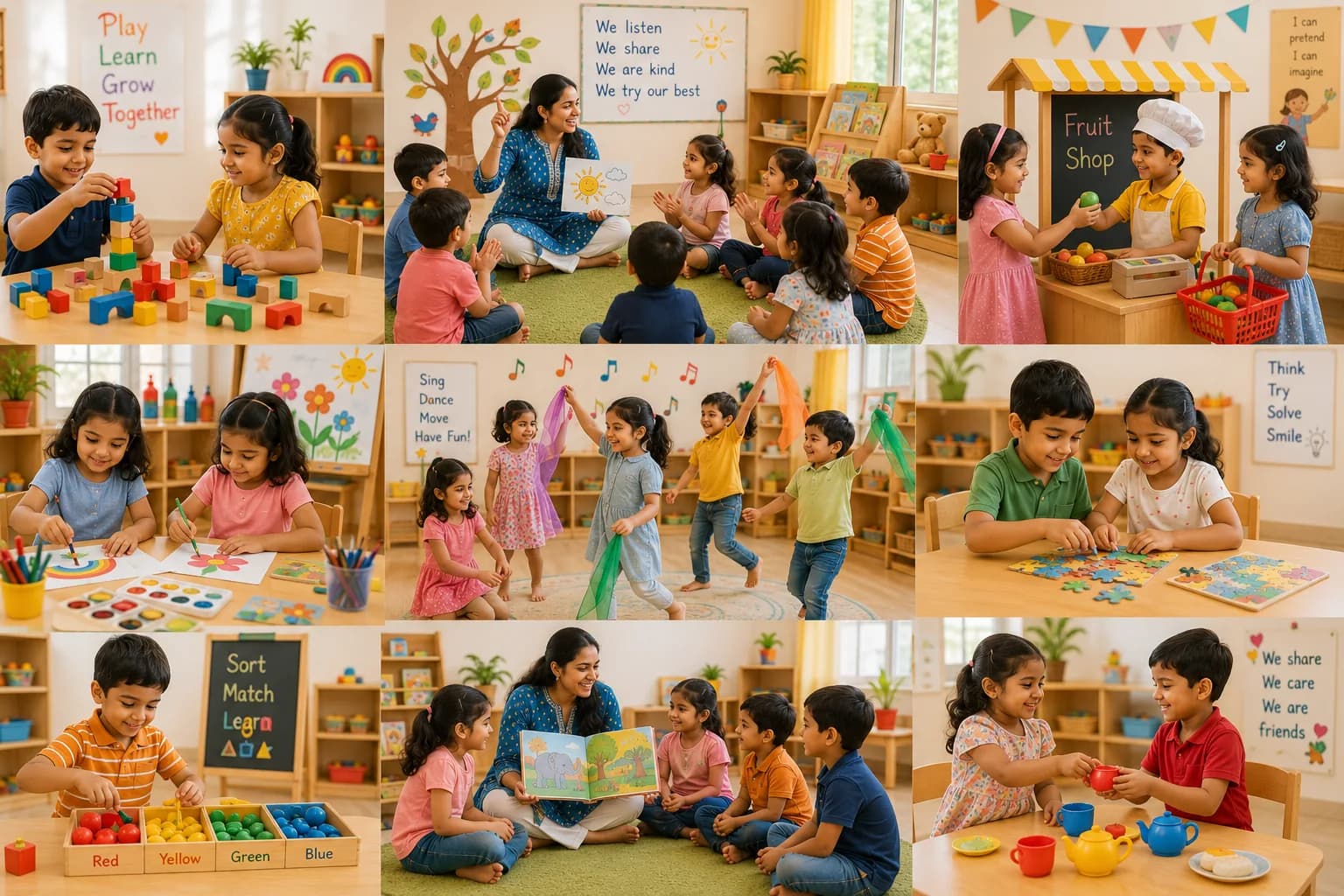
Play-based preschool learning helps children learn through guided play, hands-on activities, movement, stories, creativity, social skills, and school readiness routines.
What is play-based preschool learning?
Play-based preschool learning means children learn through active, joyful, hands-on experiences instead of only sitting, memorizing, or completing worksheets. When children build, sort, pretend, sing, move, create, listen, ask, share, and explore, they are developing language, attention, memory, fine motor skills, gross motor skills, social confidence, creativity, problem-solving, and school readiness. At Kaizen Preschool in Nallagandla, Hyderabad, play with purpose means play is joyful, but also guided carefully by teachers so children learn important early childhood skills in a natural and age-appropriate way.
Play is active learning
When children build, sort, pretend, sing, move, and create, they are also practicing attention, memory, language, coordination, and social interaction.
- Block play helps children understand balance, size, shape, counting, planning, and problem-solving.
- Sorting activities help children notice color, size, shape, pattern, difference, and similarity.
- Pretend play helps children use language, imagination, social roles, and emotional expression.
- Music and movement activities support listening, rhythm, body awareness, coordination, and confidence.
- Art and craft activities support fine motor control, creativity, patience, and self-expression.
- Group play supports sharing, waiting, turn-taking, cooperation, and friendship.
- Play-based preschool learning helps children learn through doing, not only watching or memorizing.
Why play is important in preschool
Preschool children learn best when their hands, body, senses, words, and emotions are involved. Play gives children real reasons to talk, ask, try, repeat, solve, and participate.
Play is not wasted time
A child building a tower may be learning balance, patience, counting, shapes, teamwork, and language at the same time. A simple play activity can support many areas of child development.
Teacher guidance gives direction
A caring teacher can ask questions, introduce vocabulary, model sharing, and extend a child's thinking while keeping the activity joyful.
- Teacher-guided play gives children freedom with gentle direction.
- Teachers can add new words during play, such as tall, short, heavy, light, same, different, more, less, first, next, and again.
- A teacher can ask simple questions like 'What are you making?' or 'What can we try next?'
- Teachers can model sharing, waiting, helping, asking, and solving small conflicts.
- Guided play helps children move from random activity to meaningful learning.
- Purposeful preschool activities help children build confidence without pressure.
- A warm teacher can notice each child's interest and extend learning naturally.
Guided play is different from free play
Free play gives children choice. Guided play adds teacher support, language, questions, materials, and gentle direction. Both are useful, but guided play helps connect play to learning goals.
Questions make play deeper
Simple teacher questions can help children think more. For example, 'Why did it fall?', 'Can we make it taller?', 'Which one is bigger?', and 'How can we share this?' turn play into early problem-solving.
Play way method vs traditional learning
Many parents search for the play way method because they want learning to be joyful, practical, and suitable for young children.
- The play way method uses stories, songs, movement, pretend play, hands-on materials, and teacher guidance.
- Traditional early learning may depend more on repetition, memorization, worksheets, and sitting for longer periods.
- Preschool children usually understand better when they can touch, move, speak, compare, arrange, and explore.
- Play way learning supports curiosity, confidence, language, social skills, and problem-solving.
- A balanced preschool approach can include simple worksheets later, but early learning should begin with real experiences.
- Play-based learning keeps children active and involved instead of only passive.
- The goal is not only completing an activity, but understanding, participation, and confidence.
Play way does not mean no structure
Play way learning can be structured. Teachers can plan activities with clear learning goals while keeping the experience joyful and child-friendly.
Young children need concrete learning
Before children understand symbols, letters, numbers, and worksheets deeply, they benefit from real objects, movement, stories, pictures, songs, and hands-on play.
Hands-on experiences stay longer
Young children often understand ideas better when they touch, move, compare, arrange, and talk about what they are doing.
- Hands-on learning helps preschool children understand ideas through real materials.
- Children remember better when they can touch, move, build, arrange, and explore.
- Counting real objects can be easier than only looking at numbers on a page.
- Sorting actual toys, leaves, blocks, or beads helps children understand categories.
- Clay, sand, water, blocks, puzzles, and art materials support sensory play and fine motor development.
- Hands-on preschool activities make learning active, joyful, and meaningful.
- Real-world learning helps children connect classroom concepts to daily life.
Concrete learning before abstract learning
Before children understand symbols, worksheets, and written answers, they need real experiences. Touching, comparing, arranging, and speaking about objects builds the foundation for later academic learning.
Everyday materials can teach big ideas
Cups, spoons, blocks, leaves, crayons, balls, cloth, boxes, and picture cards can help children learn counting, sorting, color, size, texture, direction, and vocabulary.
Play supports language development
Play gives children natural reasons to speak, listen, name objects, ask questions, describe actions, and share ideas.
- Pretend play helps children use daily-life words and simple sentences.
- Block play introduces words like build, fall, tall, short, more, less, strong, and again.
- Story-based play helps children retell events and use imagination.
- Group play helps children ask for a turn, request help, and respond to peers.
- Songs, rhymes, and action games support listening and speaking skills.
- Picture talk and object naming support vocabulary building for preschoolers.
- Language development through play supports communication skills and school readiness.
Children talk more when they have a reason
Children use language naturally when they want a toy, need help, explain an idea, invite a friend, describe a drawing, or continue a pretend story.
Teachers can expand simple words
If a child says 'car', a teacher can say, 'Yes, a red car is going fast.' This adds vocabulary and sentence structure without pressure.
Play builds social skills and values
Group play naturally creates moments for waiting, helping, thanking, sharing, listening, and solving small conflicts with guidance.
- Children learn to wait for turns during games and shared activities.
- Sharing toys helps children understand patience and cooperation.
- Group play teaches children to listen to others and respond kindly.
- Small conflicts become chances to practice words like 'please', 'sorry', 'my turn', and 'your turn'.
- Play supports values such as kindness, respect, responsibility, and helping.
- Teacher guidance helps children solve small disagreements calmly.
- Social skills through play help children feel more comfortable in a preschool classroom.
Values are learned in real moments
Children understand values better when they experience them. Helping a friend, sharing blocks, cleaning up together, or waiting during a game can teach more than a long lecture.
Play supports joyful discipline
Purposeful play helps children practice routines, listening, boundaries, responsibility, and self-control in a warm and natural way.
Play supports problem-solving and thinking
Purposeful play helps preschool children observe, compare, predict, try again, and find simple solutions.
- Puzzle play helps children match shapes, notice patterns, and persist.
- Building activities help children test balance, height, size, and stability.
- Sorting games support comparing, classifying, and decision-making.
- Pretend play helps children plan roles, follow sequences, and solve social problems.
- Science-like play with water, sand, leaves, magnets, or shadows supports curiosity.
- Problem-solving activities for preschoolers build patience and confidence.
- Children learn that mistakes are part of trying and improving.
Trying again builds confidence
When a tower falls, a child can rebuild it. When a puzzle piece does not fit, the child can try another. These small play moments build persistence and confidence.
Play builds early thinking skills
Observation, comparison, sequencing, prediction, memory, attention, and flexible thinking can all grow through play-based learning.
How play prepares children for kindergarten
Play-based learning supports kindergarten readiness by building the habits and skills children need before formal school learning becomes heavier.
- Listening during stories and circle time supports classroom attention.
- Fine motor play prepares the hand for drawing, coloring, tracing, and writing readiness.
- Counting objects, sorting, matching, and pattern games support early math thinking.
- Pretend play and show-and-tell support speaking confidence.
- Group games support following instructions, waiting, sharing, and cooperation.
- Clean-up routines support responsibility and independence.
- Play-based school readiness helps children prepare for the next stage without pressure-heavy learning.
Kindergarten readiness is more than academics
Before moving into formal school, children need confidence, independence, listening, speaking, fine motor control, social comfort, routine awareness, and willingness to learn.
Play builds readiness naturally
A child who can listen, ask, share, build, count, retell, clean up, and try again is building important readiness skills through play.
Play-based learning by age group
Play with purpose should match the child's age, attention span, movement needs, language level, and readiness.
- For playgroup children aged 2 to 3 years, useful play activities include stacking blocks, water play, action songs, pretend feeding, clay squeezing, picture naming, and simple movement games.
- For nursery children aged 3 to 4 years, useful activities include sorting, matching, pretend play, rhymes, puzzles, finger painting, story listening, and outdoor games.
- For PP1 children aged 4 to 5 years, purposeful play can include pattern games, counting objects, storytelling, role play, building challenges, art projects, and nature observation.
- For PP2 children aged 5 to 6 years, play can support school readiness through board games, story retelling, number games, early writing readiness, group projects, and simple science exploration.
- Age-wise preschool activities help children stay engaged without pressure.
- Play-based curriculum should slowly build independence, communication, focus, and confidence.
- Each age group benefits from a balance of movement, language, creativity, social play, and hands-on discovery.
Playgroup and nursery need simple repetition
Younger preschool children learn through short, repeated, sensory-rich activities. They need movement, naming, songs, simple choices, and familiar routines.
PP1 and PP2 can handle longer play projects
Older preschool children can participate in more structured play such as story sequencing, role play, early math games, group activities, and simple problem-solving tasks.
Parents can notice the learning
A simple classroom activity may support many skills at once, including language, confidence, fine motor control, problem-solving, and social comfort.
- When a child builds blocks, parents can notice planning, balance, counting, and problem-solving.
- When a child paints, parents can notice creativity, hand control, color naming, and patience.
- When a child plays with friends, parents can notice sharing, turn-taking, language, and confidence.
- When a child sings rhymes, parents can notice listening, memory, rhythm, pronunciation, and participation.
- When a child sorts objects, parents can notice observation, comparison, vocabulary, and early math thinking.
- Preschool learning through play may look simple, but it supports many early childhood skills.
- Parents can ask teachers what skill was supported through each activity.
Ask what the child learned through play
Instead of asking only about worksheets, parents can ask: What did my child explore today? Did my child speak during play? Did my child share? Did my child try a new activity? Did my child solve a small problem?
Learning is visible in behavior
A child who waits, asks, shares, builds, sings, tries again, cleans up, and explains ideas is showing important signs of early learning.
Play-based learning at home
Parents can support purposeful play at home using simple materials, daily routines, and short activities.
- Use blocks, cups, spoons, boxes, crayons, clay, leaves, balls, and picture books for simple play activities.
- Ask open questions like 'What are you making?', 'What happened?', and 'What can we try next?'
- Let children help with small chores such as arranging toys, folding napkins, watering plants, or packing the school bag.
- Use pretend play such as shop, kitchen, doctor, teacher, bus, or family play.
- Read picture books and invite the child to point, name, predict, and retell.
- Encourage outdoor play, movement games, balancing, jumping, and ball play.
- Keep play joyful and do not turn every activity into a test.
Simple play ideas for parents
Parents can try sorting vegetables by color, counting spoons, making a pretend shop, drawing a family picture, building with boxes, singing action rhymes, or asking the child to tell a story about a toy.
Do not over-direct the child
Purposeful play does not mean adults control every step. Children need choice, imagination, and time to explore. Adults can gently guide when needed.
What parents should ask about play-based learning during a preschool visit
When parents visit a preschool, they can look beyond toys and ask how play is planned, guided, observed, and connected to child development.
- Ask how teachers guide play without making it too rigid.
- Ask how play supports language, early math, movement, creativity, and social skills.
- Ask how the school balances free play, guided play, routines, stories, and outdoor play.
- Ask how teachers observe child progress during play-based activities.
- Ask how activities are different for playgroup, nursery, PP1, and PP2 children.
- Ask how the preschool builds school readiness without pressure-heavy learning.
- Ask how parents are informed about the learning behind classroom activities.
Observe the classroom environment
During a school visit, parents can observe whether children are engaged, comfortable, speaking, sharing, moving, exploring materials, and receiving warm teacher guidance.
Look for purposeful play, not only toys
A play-based preschool should not only have toys. It should have teacher interaction, planned activities, routines, stories, music, movement, creative work, and hands-on learning experiences.
How Kaizen Preschool supports play with purpose
At Kaizen Preschool, play is treated as a serious method of early learning, supported by caring teachers, routines, stories, movement, creativity, and hands-on activities.
- Children learn through play-based activities that are joyful and age-appropriate.
- Teachers guide play through questions, vocabulary, modeling, observation, and gentle support.
- Classroom routines help children build independence, listening, participation, and confidence.
- Stories, songs, rhymes, movement, pretend play, and hands-on materials support early learning.
- Children are encouraged to explore, speak, share, create, move, and solve problems.
- Play with purpose supports school readiness without pressure-heavy learning.
- Parents looking for a play-based preschool in Nallagandla can observe how children learn through guided play, routines, and real activities.
A play-based preschool near Nallagandla
For parents searching for a play-based preschool near Nallagandla, Serilingampalle, Tellapur, Gopanpally, Lingampally, Gachibowli, Financial District, Nanakramguda, or Kokapet, it is helpful to observe whether the preschool offers hands-on learning, teacher-guided play, movement, stories, creativity, social interaction, and age-wise learning experiences.
Play with purpose supports confident beginnings
Purposeful play helps children enjoy childhood while slowly building language, habits, values, creativity, problem-solving, confidence, and readiness for the next stage.
Play with purpose builds strong early foundations
Play-based preschool learning gives children the chance to explore, speak, move, create, share, think, and try again. When play is guided with care, it supports language development, motor skills, creativity, problem-solving, social skills, values, independence, kindergarten readiness, and school readiness. In the preschool years, learning should feel joyful and meaningful. At Kaizen Preschool in Nallagandla, Hyderabad, play with purpose helps children grow through hands-on activities, caring teacher guidance, classroom routines, stories, movement, creativity, and real-world experiences.
FAQs
Common parent questions
What is play-based preschool learning?
Play-based preschool learning means children learn through active experiences such as building, sorting, pretending, singing, moving, creating, storytelling, and guided interaction instead of only memorizing or doing worksheets.
What does play with purpose mean in preschool?
Play with purpose means children enjoy play while teachers gently guide language, thinking, habits, creativity, social skills, problem-solving, and school readiness.
What is the play way method in preschool?
The play way method uses stories, songs, movement, pretend play, hands-on activities, and teacher guidance to help young children learn naturally and joyfully.
Why is play important in preschool?
Play is important because young children learn through movement, touch, conversation, imagination, repetition, and social interaction. Play supports language, confidence, coordination, thinking, and emotional growth.
How does play help child development?
Play helps child development by supporting fine motor skills, gross motor skills, language, creativity, memory, attention, problem-solving, sharing, waiting, and independence.
Is play-based learning better than worksheets for preschool children?
Preschool children need hands-on experiences before heavy worksheet learning. Worksheets may have limited use, but play-based learning helps children understand ideas through real materials, movement, language, and exploration.
What are examples of play-based preschool activities?
Examples include block play, pretend play, sorting games, puzzles, clay play, painting, storytelling, rhymes, outdoor play, water play, movement games, and simple science observation.
What is the difference between free play and guided play?
Free play gives children choice, while guided play includes teacher support through questions, vocabulary, materials, observation, and gentle direction.
How do teachers guide play in preschool?
Teachers guide play by asking questions, adding vocabulary, modeling sharing, offering materials, observing children, extending ideas, and helping children solve small problems.
How does play support language development?
Play gives children natural reasons to speak, listen, ask questions, name objects, describe actions, retell stories, and interact with friends and teachers.
Is play-based learning good for school readiness?
Yes. Play-based learning supports listening, speaking, focus, fine motor skills, social confidence, independence, problem-solving, early thinking skills, and classroom participation.
How does play support kindergarten readiness?
Play supports kindergarten readiness by helping children build listening, focus, early math thinking, language, hand control, group participation, independence, and confidence.
What play activities can parents do at home?
Parents can use blocks, clay, crayons, picture books, pretend play, sorting objects, action songs, outdoor walks, puzzles, and simple household helper tasks.
What should parents ask when visiting a play-based preschool?
Parents can ask how teachers guide play, how activities support learning, how routines are managed, how progress is observed, and how school readiness is built without pressure.
What should parents look for in a play-based preschool near Nallagandla?
Parents can observe whether the preschool offers guided play, hands-on activities, stories, movement, creativity, social learning, teacher interaction, routines, and age-wise learning experiences.
How does Kaizen Preschool support play with purpose?
Kaizen Preschool supports play with purpose through teacher-guided play, stories, songs, movement, hands-on activities, routines, creativity, social learning, values, and school readiness activities.
Next steps
Helpful next steps
Continue with these related pages before booking a school visit or admission conversation.
Want to discuss your child's next step?
Book a school visit, call, or WhatsApp Kaizen Preschool to understand programs, daycare, admissions, and readiness support in Nallagandla.