multilingual preschool language development
Multilingual Preschool Language Development
Learn how multilingual comfort supports preschool language development, expression, classroom confidence, and parent partnership at Kaizen Preschool.
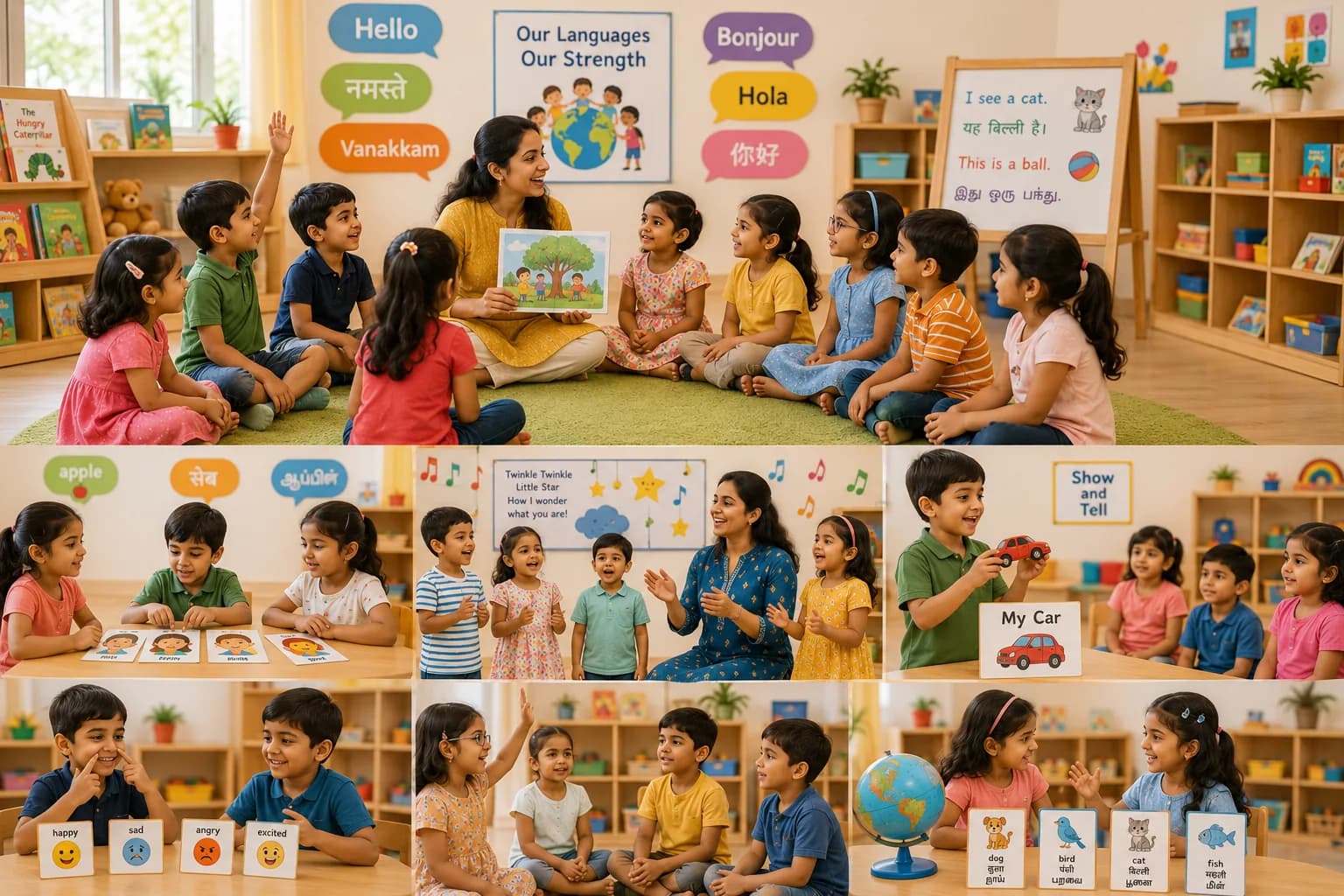
Multilingual preschool language development helps children feel included, express themselves, build English exposure, and grow in classroom communication with comfort.
What is multilingual preschool language development?
Multilingual preschool language development means helping young children feel safe, included, and confident when they come from different home language backgrounds. Many children in Nallagandla and nearby areas may hear Telugu, Hindi, English, or another home language before entering preschool. A warm preschool classroom should respect the child's home language while gently building English exposure, classroom language, listening skills, speaking confidence, vocabulary, and communication habits. At Kaizen Preschool in Nallagandla, language development is supported through stories, songs, routines, picture talk, gestures, play, conversation, circle time, show-and-tell, and caring teacher guidance.
Home language brings comfort
Children may settle more easily when adults understand that home language is part of their emotional world, family connection, and identity.
- A child's home language helps them feel emotionally safe in a new preschool environment.
- When teachers respect the child's familiar words, the child may feel more included and understood.
- Home language support in preschool can reduce fear, silence, and separation discomfort.
- Children often express feelings, needs, and ideas first in the language they know best.
- Respecting home language does not stop English learning; it can support confidence for new language growth.
- Multilingual comfort helps children move gradually from home language to shared classroom language.
- Mother tongue support in preschool can help children feel seen, heard, and emotionally secure.
Language is connected to emotion
For a young child, language is not only about words. It is connected to comfort, family, food, stories, songs, affection, and daily routines. When adults value the child's familiar language, the child may feel safer to participate.
Home language and school language can work together
A child can hear and use home language while also learning classroom words in English. The goal is not to remove the child's first language, but to slowly build confidence in both familiar and new language situations.
English exposure should be gradual and natural
Preschool children build English confidence better through repeated classroom phrases, songs, stories, picture cards, actions, play, and daily routines than through pressure.
- English exposure for preschoolers should begin with simple words, actions, and daily classroom phrases.
- Repeated phrases like 'come here', 'wash hands', 'sit down', 'clean up', and 'your turn' help children understand classroom language.
- Songs and rhymes make new English words easier to remember.
- Picture cards, objects, gestures, and actions help children connect meaning with words.
- Children should be encouraged to try new words without fear of mistakes.
- English speaking confidence for preschoolers grows slowly through listening, repetition, play, and teacher support.
- English exposure without pressure helps children participate without feeling forced to speak perfectly.
Pressure can make children quiet
If children are forced to speak only in one language before they are ready, they may become silent or anxious. A supportive preschool gives children time to listen, understand, repeat, and slowly speak.
Classroom phrases build confidence
Daily phrases become powerful language tools. When children hear the same words during snack, clean-up, circle time, play time, and dispersal, they slowly understand and begin to use them.
Shared classroom language grows gradually
Songs, routines, gestures, picture cards, repeated phrases, and peer interaction help children understand classroom language over time.
- Shared classroom language helps children participate in group routines and activities.
- Children first understand many words before they begin using them confidently.
- Gestures and visual cues help children follow instructions even when words are new.
- Peer interaction helps children hear natural classroom language during play.
- Routine-based language supports listening, speaking, cooperation, and independence.
- Language-rich preschool classrooms give children many chances to hear and use words naturally.
- Classroom language for preschoolers grows through repeated use during real activities.
Understanding comes before speaking
A child may understand classroom instructions before speaking clearly. This is a normal part of language development. Teachers can observe whether the child follows gestures, responds to routines, points, nods, imitates, or uses small words.
Visual support helps multilingual children
Picture cards, object naming, action songs, classroom labels, story pictures, and teacher gestures make language easier for children who are still adjusting to classroom English.
Child speaks at home but not at preschool
Some children speak comfortably at home but become quiet in preschool. This can happen when the classroom is new, the language feels unfamiliar, or the child needs more time to feel safe.
- A child may observe quietly before speaking in a new preschool classroom.
- Some children speak more at home because the people, language, and routines are familiar.
- A child who is quiet at school may still be listening, understanding, and learning.
- Teacher warmth, predictable routines, peer play, and repeated phrases can slowly improve participation.
- Low-pressure communication helps children try words when they are ready.
- Parents and teachers should share observations instead of quickly labeling the child as shy or delayed.
- If there are strong concerns about speech and language development, parents can consult a qualified professional.
Quiet does not always mean lack of learning
Some children need a silent observation phase before they begin speaking in a new classroom. They may first respond through eye contact, gestures, pointing, nodding, following routines, or joining actions.
How adults can support a quiet child
Adults can offer choices, use familiar songs, pair the child with friendly peers, repeat simple phrases, smile often, avoid public pressure, and celebrate small attempts to communicate.
Expression matters first
Children should be encouraged to communicate needs, feelings, and ideas in the ways available to them while new words grow.
- Preschool communication begins with comfort, not perfect sentences.
- Children may communicate through words, gestures, pointing, facial expressions, sounds, or short phrases.
- Teachers can gently expand a child's words without correcting harshly.
- A child who feels heard is more likely to try new words.
- Language confidence in preschool grows when children are allowed to express first and improve gradually.
- Oral language development supports social skills, emotional expression, and school readiness.
- Communication skills for preschoolers grow through repeated, meaningful interaction.
Correct gently, not constantly
If a child says one word or uses mixed language, the adult can respond with a full sentence. For example, if the child says 'water', the adult can say, 'You want water. Here is your water.' This builds language without pressure.
Mixed language is common
Many multilingual children mix words from different languages while learning. This does not need to be treated as a problem. With repeated exposure and conversation, children gradually learn when and how to use different words.
Language activities parents can try at home
Parents can support multilingual preschool language development at home through simple daily language activities that do not feel like formal teaching.
- Picture talk: point to pictures and ask what the child sees.
- Object naming: name fruits, clothes, toys, colors, vehicles, animals, and household items.
- Choice questions: ask 'Do you want apple or banana?' instead of only yes-or-no questions.
- Action songs: sing rhymes with clapping, jumping, pointing, and movement.
- Story retelling: ask the child to tell what happened first, next, and last.
- Pretend phone call: let the child act like they are calling a grandparent, teacher, or friend.
- Show and tell: ask the child to show one object and say 2 or 3 words about it.
- Daily routine talk: use repeated words during brushing, bathing, eating, dressing, and bedtime.
Use both home language and English
Parents can use the home language for comfort and add simple English words naturally. For example, a parent may say the word in the home language and then add the English word during daily routines.
Do not turn every moment into a test
Language activities work best when children feel relaxed. Instead of asking too many questions, parents can talk naturally, wait for the child to respond, and enjoy the conversation.
Stories support many languages
Storytelling, picture talk, rhymes, and repetition can help children connect meaning across familiar and new words.
- Stories help children hear new words in a meaningful context.
- Picture talk supports vocabulary building for preschoolers.
- Rhymes and songs support pronunciation, rhythm, listening, and memory.
- Retelling stories helps children organize thoughts and speak with confidence.
- Familiar stories can be discussed in home language and classroom language.
- Storytelling for language development helps children connect words, feelings, actions, and imagination.
- Storytelling activities for preschoolers support vocabulary, listening, memory, and speaking.
Picture talk builds vocabulary
Teachers and parents can point to pictures and name people, objects, colors, actions, emotions, and places. Simple questions such as 'What is this?', 'Who is running?', and 'How is the child feeling?' build vocabulary and thinking.
Repetition helps children speak
Children enjoy hearing the same stories and rhymes again and again. Repetition helps them remember words, predict what comes next, and slowly join the storytelling.
Play-based language learning works well
Young children learn language naturally when they play, pretend, ask, listen, name objects, follow actions, and talk with adults and peers.
- Pretend play gives children chances to use words from daily life.
- Block play can introduce words like tall, small, more, less, fall, build, and again.
- Outdoor play can build vocabulary around nature, movement, direction, and observation.
- Sorting and matching games support naming, describing, comparing, and listening.
- Circle time supports group language, turn-taking, rhymes, greetings, and simple questions.
- Play-based language learning makes communication joyful and practical.
- Language activities for preschoolers work better when they are playful, repeated, and connected to real life.
Every activity can become language-rich
Snack time, clean-up time, art, music, outdoor play, clay work, and pretend play can all support language development when adults name actions, ask questions, and encourage children to respond.
Language grows through use
Children do not build communication skills only by repeating words. They need real reasons to use language: asking for help, sharing ideas, telling stories, making friends, choosing materials, and expressing feelings.
Language support by age group
Language development in preschool should match the child's age, confidence, attention span, and social readiness.
- For playgroup children aged 2 to 3 years, language support can include naming objects, action songs, simple instructions, picture pointing, greetings, and short phrases.
- For nursery children aged 3 to 4 years, teachers can use rhymes, picture talk, pretend play, simple questions, story listening, and daily classroom phrases.
- For PP1 children aged 4 to 5 years, language support can include storytelling, show-and-tell, role play, sequencing cards, vocabulary games, and group conversation.
- For PP2 children aged 5 to 6 years, children can practice story retelling, longer sentences, describing pictures, early reading readiness, phonics exposure, and classroom discussion.
- Language activities for 3 year olds should be short, repetitive, and picture-based.
- Language activities for 4 year olds can include stories, pretend play, rhymes, and simple group conversation.
- Language activities for 5 year olds can include show-and-tell, story retelling, describing pictures, and early school readiness language skills.
- The goal is steady growth in listening, speaking, vocabulary, expression, and school readiness language skills.
Do not compare children
Children develop language at different speeds. Some children speak early, some observe quietly, and some need more time to adjust to preschool. Support should be based on observation, comfort, and gradual progress.
School readiness includes language confidence
Before primary school, children benefit from listening to instructions, asking for help, expressing needs, participating in group talk, understanding stories, and using words to interact with others.
Parents can support consistency
Families can read, talk, sing, and name everyday objects at home while teachers support language confidence in school routines.
- Parents can talk to children during daily routines such as eating, bathing, dressing, walking, and packing the school bag.
- Reading picture books at home supports vocabulary, listening, attention, and imagination.
- Singing rhymes in home language and English can support sound awareness and memory.
- Parents can name objects, actions, colors, feelings, and people during normal daily life.
- Children benefit when parents do not shame them for pronunciation mistakes or mixed language.
- Home and school consistency helps children build communication confidence.
- Parents can help children speak English confidently by using simple repeated phrases without pressure.
Keep home language strong
Parents do not need to stop using the home language to help a child learn English. A strong home language can support thinking, emotional expression, family bonding, and later language learning.
Add English gently
Parents can add simple English words during daily routines. For example: 'This is your cup', 'Wear your shoes', 'Wash hands', 'Story time', and 'Good night'. Small repeated phrases help children understand naturally.
Common parent worries about multilingual children
Many parents worry when their child mixes languages, speaks less in school, or takes time to respond in English. In many cases, children need comfort, exposure, repetition, and time.
- A child may be quiet in the first few weeks of preschool while observing the new environment.
- A child may understand instructions before speaking clearly.
- A child may mix home language and English while learning.
- A child may use gestures before using full sentences.
- A child may speak more at home than at school until classroom comfort improves.
- Preschool child language delay concerns should be discussed carefully through observation, not quick comparison.
- If parents are concerned about speech delay, they should discuss observations with teachers and consult a qualified professional when needed.
Silence is not always lack of learning
Some children listen quietly before they begin speaking in a new environment. Teachers can support them through smiles, gestures, peer play, repeated phrases, and low-pressure participation.
When to seek additional support
If a child shows very limited response to sound, does not try to communicate needs, loses previously used words, or parents have strong concerns, it is better to speak with a qualified child development or speech-language professional.
How Kaizen Preschool supports multilingual comfort
At Kaizen Preschool, children are supported through language-rich routines, caring teacher guidance, stories, songs, picture talk, gestures, play, gradual English exposure, and communication-friendly classroom routines.
- Children are encouraged to express needs, feelings, and ideas with comfort.
- Teachers use repeated classroom phrases, routines, gestures, and visual support.
- Stories, rhymes, songs, and picture talk support vocabulary and listening.
- Play-based activities give children natural reasons to communicate.
- Home language comfort is respected while classroom language grows gradually.
- Language confidence is built without pressure-heavy expectations.
- Multilingual preschool language development is supported through warmth, repetition, observation, and teacher guidance.
A language-friendly preschool near Nallagandla
For parents looking for a multilingual preschool in Nallagandla, Serilingampalle, Tellapur, Gopanpally, or Lingampally, it is helpful to observe how the school supports communication, teacher-child interaction, story time, rhymes, classroom routines, English exposure, child comfort, and speaking confidence.
Multilingual comfort builds language confidence
Multilingual preschool language development helps children feel seen, heard, and included. When a child's home language is respected and classroom language is introduced gently, the child gets more confidence to listen, speak, ask, respond, and participate. In the preschool years, language development should grow through warmth, stories, songs, routines, play, repetition, picture talk, show-and-tell, circle time, and caring adult interaction. With the right support from parents and teachers, children can build strong communication skills, English exposure, social confidence, and school readiness without losing emotional comfort.
FAQs
Common parent questions
What is multilingual preschool language development?
Multilingual preschool language development means helping children from different home language backgrounds build comfort, communication skills, English exposure, vocabulary, listening, speaking, and classroom language gradually.
What is multilingual comfort in preschool?
Multilingual comfort in preschool means helping children feel safe and confident when they come from different home language backgrounds while gradually building classroom language, English exposure, and communication skills.
Will using home language delay English learning?
Using home language does not automatically delay English learning. A strong home language can support thinking, emotional expression, family bonding, and later language growth when English exposure is introduced naturally.
How do preschool children learn English?
Preschool children learn English through repeated classroom phrases, songs, rhymes, stories, picture talk, gestures, play, routines, peer interaction, and caring teacher guidance.
Why does my child speak at home but not in preschool?
Some children need time to feel comfortable in a new classroom. They may observe quietly before speaking. Gentle routines, teacher warmth, peer play, and repeated phrases can help them slowly participate.
How can I help my child speak English confidently?
Use simple English phrases during daily routines, read picture books, sing rhymes, ask choice questions, use show-and-tell, and allow the child to respond without pressure.
Is it normal for preschool children to mix languages?
Yes. Many multilingual children mix words from different languages while learning. With regular exposure, repetition, and conversation, they gradually understand when and how to use different words.
What language activities help 3 to 5 year old children?
Picture talk, storytelling, rhymes, pretend play, show-and-tell, action songs, object naming, story retelling, and daily routine talk help preschool children build vocabulary and speaking confidence.
What should parents do if a child speaks less in school?
Some children observe quietly before speaking in a new classroom. Parents and teachers can support the child with comfort, predictable routines, gentle encouragement, stories, rhymes, and low-pressure communication.
How can parents support language development at home?
Parents can talk during daily routines, read picture books, sing rhymes, name objects, ask simple questions, listen patiently, use both home language and simple English, and avoid shaming the child for mistakes or mixed language.
What are good language activities for preschoolers?
Good language activities include picture talk, storytelling, rhymes, action songs, pretend play, object naming, show-and-tell, sorting games, role play, circle time language games, and story retelling.
How does storytelling help language development?
Storytelling helps children build vocabulary, listening, memory, imagination, sequencing, emotional understanding, and speaking confidence.
What language skills are important for school readiness?
Important school readiness language skills include listening to instructions, expressing needs, asking for help, naming objects, participating in group talk, understanding stories, and using words in social situations.
How does Kaizen Preschool support multilingual comfort?
Kaizen Preschool supports multilingual comfort through classroom routines, stories, songs, rhymes, picture talk, gestures, play-based activities, gradual English exposure, and caring teacher guidance.
What should I look for in a multilingual preschool near Nallagandla?
Parents can observe whether the preschool respects home language comfort, supports English exposure gently, encourages expression, uses stories and songs, builds classroom language through routines, and gives children enough time to speak with confidence.
Next steps
Helpful next steps
Continue with these related pages before booking a school visit or admission conversation.
Want to discuss your child's next step?
Book a school visit, call, or WhatsApp Kaizen Preschool to understand programs, daycare, admissions, and readiness support in Nallagandla.