low-screen early learning for preschoolers
Low-Screen Early Learning for Preschoolers
Explore low-screen early learning for preschoolers through books, movement, hands-on activities, storytelling, outdoor play, routines, and creativity.
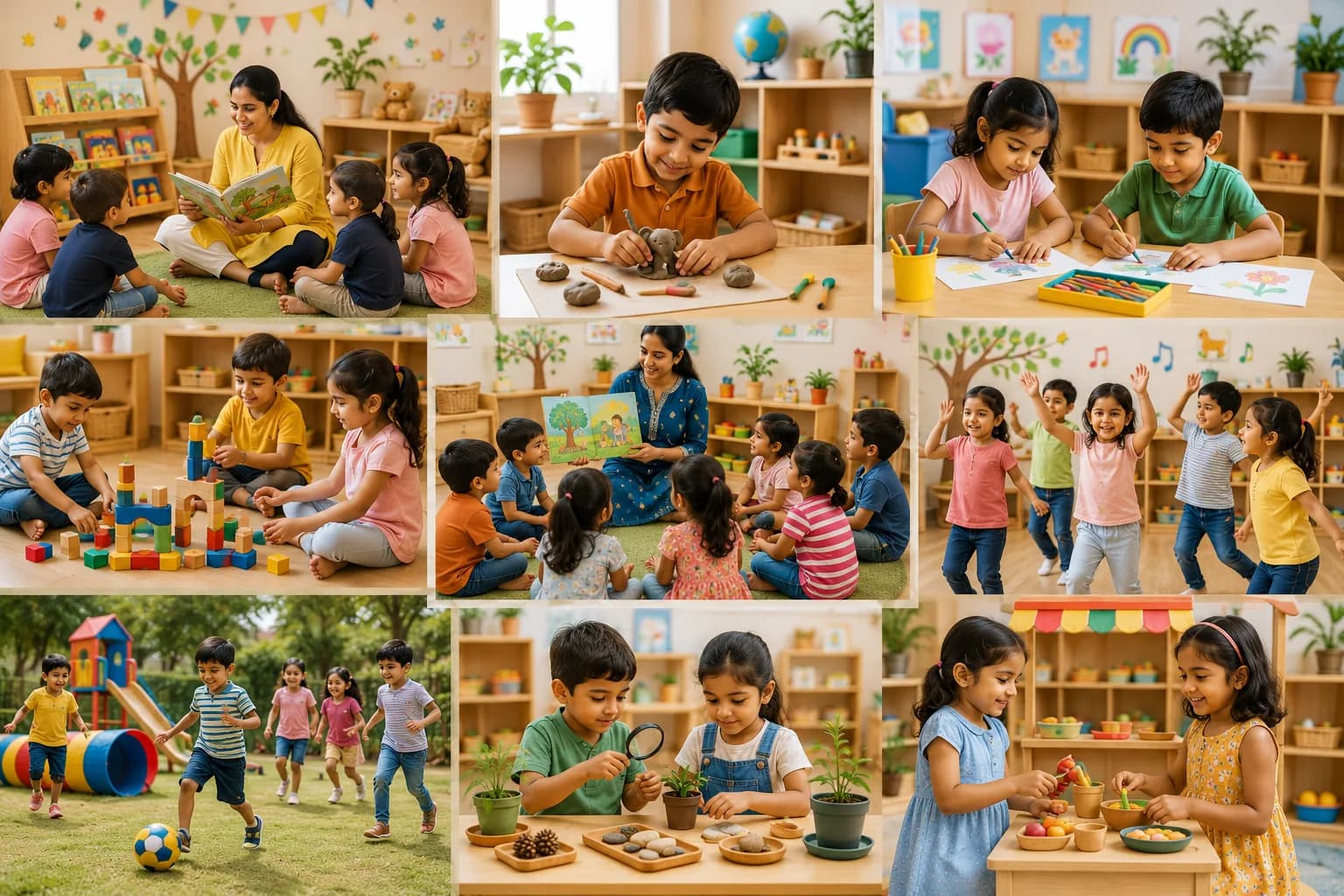
Low-screen early learning gives preschool children more time for movement, conversation, books, creative work, sensory play, outdoor play, and hands-on discovery.
What is low-screen early learning?
Low-screen early learning means giving young children more opportunities to learn through real-world experiences instead of depending mainly on mobile phones, tablets, television, or digital content. In the preschool years, children learn best through conversation, movement, touch, play, stories, music, books, outdoor activities, routines, and caring adult interaction. At Kaizen Preschool in Nallagandla, low-screen learning is seen as a practical way to support language development, social skills, creativity, attention, independence, and school readiness without making children dependent on screens.
Young children need real interaction
Conversation, eye contact, stories, songs, questions, and group play help children build language, confidence, attention, and social skills.
- Young children learn language faster when adults talk, listen, respond, and ask simple questions.
- Real conversation helps children build vocabulary, sentence formation, listening habits, and confidence.
- Eye contact, facial expressions, gestures, and tone of voice help children understand emotions and social cues.
- Group play teaches sharing, waiting, turn-taking, cooperation, and problem-solving.
- Low-screen early learning gives children more time to speak, ask, listen, imagine, and connect with others.
- Preschool activities based on conversation and play support emotional development and school readiness.
Why screens cannot replace interaction
Videos may show words, songs, or pictures, but they cannot fully replace a caring adult who listens, responds, explains, encourages, and guides the child. Preschool children need two-way interaction, not only one-way watching.
Simple interaction ideas for parents
Parents can talk during daily routines such as bathing, dressing, eating, walking, packing the school bag, watering plants, or arranging toys. Simple questions like 'What do you see?', 'What comes next?', and 'How do you feel?' support early language development.
Screen time alternatives for preschool children
Parents often want practical screen-free activities that are easy to do at home. The best screen time alternatives are simple, repeatable, safe, and connected to real life.
- Story basket: keep 3 to 5 picture books or story cards in one basket.
- Busy box: add crayons, paper, stickers, blocks, clay, and safe sorting objects.
- Movement jar: write simple actions like jump, clap, crawl, spin, stretch, and balance.
- Helper routine: let the child help with napkins, spoons, toys, plants, or school bag items.
- Pretend play corner: use toy kitchen items, doctor set, dolls, vehicles, animals, or household objects.
- Outdoor mini-walk: observe trees, flowers, vehicles, birds, clouds, and sounds.
- Music time: sing rhymes, clap beats, dance, or play simple rhythm games.
Keep activities short
Preschool children do not need long activity sessions. Even 10 to 15 minutes of focused conversation, movement, reading, or creative play can become meaningful early learning.
Repeat favorite activities
Children enjoy repetition. Repeating the same story, game, rhyme, or activity helps them remember, participate, and gain confidence.
Movement supports learning
Jumping, balancing, dancing, outdoor play, and fine motor activities support body awareness, coordination, attention, and confidence.
- Gross motor activities such as running, jumping, crawling, balancing, dancing, and climbing support strength and coordination.
- Fine motor activities such as tearing paper, threading beads, clay play, drawing, coloring, sorting, and stacking prepare children for writing readiness.
- Movement activities help preschool children release energy in a healthy way.
- Outdoor play supports attention, body awareness, social play, and emotional regulation.
- Children who move, explore, and play actively get meaningful alternatives to passive screen time.
- Preschool learning activities should include both active movement and calm focus time.
Movement before worksheets
Before children are ready for long writing tasks, they need strong shoulders, flexible wrists, finger control, eye-hand coordination, balance, and body confidence. Movement and fine motor play build these foundations naturally.
Easy low-screen movement ideas
Parents can try animal walks, hopscotch, ball rolling, balloon tapping, balancing on a line, dance freeze games, simple yoga poses, and clean-up races. These activities are fun, active, and screen-free.
Books and stories build imagination
Picture books, storytelling, rhymes, and retelling activities help children listen, remember, predict, speak, and imagine.
- Picture books help children connect words with images, emotions, characters, and events.
- Storytelling builds listening skills, memory, imagination, vocabulary, and sequencing.
- Rhymes and songs support sound awareness, rhythm, pronunciation, and early literacy.
- Retelling a story helps children organize thoughts and speak with confidence.
- Books are one of the strongest screen time alternatives for preschool children.
- A daily reading routine can slowly build attention span and love for learning.
How parents can make books engaging
Parents do not need to read perfectly. They can point to pictures, change voice for characters, ask what may happen next, let the child turn pages, and connect the story to real life.
Storytelling without screens
A bedtime story, family story, festival story, animal story, or simple pretend story can become a powerful low-screen learning moment. Children enjoy repetition, funny sounds, familiar characters, and emotional endings.
Creative work builds patience
Drawing, clay, collage, pretend play, music, and craft help children plan, try, repeat, and express ideas.
- Creative activities help preschool children express thoughts, feelings, stories, and imagination.
- Clay play, collage, painting, drawing, and craft build fine motor control and patience.
- Pretend play supports language, social confidence, problem-solving, and emotional understanding.
- Music and rhythm activities support listening, movement, memory, and joyful participation.
- Hands-on learning helps children learn through doing, not only watching.
- Creative work gives children a healthy alternative to mobile phone and television time.
Process matters more than perfect output
In preschool years, the goal of art and craft is not a perfect final product. The real learning happens when the child chooses, tries, mixes, folds, tears, presses, draws, explains, and repeats.
Low-cost creative activities at home
Parents can use paper scraps, old boxes, leaves, spoons, cotton, bottle caps, crayons, clay, water, and safe household items for creative play. Children do not need expensive toys to learn.
Low-screen activity ideas by age
Low-screen activities work best when they match the child's age, attention span, movement needs, and development stage.
- For toddlers and playgroup children aged 2 to 3 years, choose simple activities like stacking blocks, water play, clay squeezing, picture naming, action songs, pretend feeding, and short outdoor walks.
- For nursery children aged 3 to 4 years, use sorting games, matching cards, rhymes, picture books, pretend play, simple puzzles, finger painting, and movement games.
- For PP1 children aged 4 to 5 years, try storytelling, pattern games, counting objects, drawing, cutting practice with supervision, role play, building blocks, and nature observation.
- For PP2 children aged 5 to 6 years, include story retelling, early writing practice, number games, board games, art projects, simple science observation, responsibility charts, and group games.
- Age-wise screen-free activities help children stay engaged without pressure.
- Activities should be short, joyful, hands-on, and repeated regularly.
Match activity to attention span
A 2-year-old may enjoy a short 5-minute activity, while a 5-year-old may stay with a story, puzzle, or art task for longer. The goal is not to force attention, but to slowly build it through enjoyable experiences.
Use everyday materials
Many low-screen activities can be done with household items such as spoons, cups, cloth, boxes, leaves, paper, crayons, water, clay, and safe kitchen objects. Real materials make learning more meaningful.
Routines reduce screen dependence
A predictable day with play, rest, chores, books, and outdoor time gives children meaningful alternatives to screens.
- Children ask for screens more often when they are bored, tired, hungry, or unsure what to do next.
- A simple daily routine gives children structure and reduces screen dependence.
- Screen-free routines can include breakfast talk, school time, outdoor play, quiet play, story time, and bedtime.
- Small household responsibilities like arranging toys or placing the water bottle in the bag build independence.
- Predictable routines support emotional security, cooperation, and self-control.
- Early childhood routines help children move from passive entertainment to active participation.
Create a screen-time boundary
Parents can decide a clear screen-time rule and keep it consistent. Sudden removal often causes resistance, but a predictable start and stop time helps children adjust better.
Give children something to do next
Instead of only saying 'No screen', parents can offer the next activity: blocks, coloring, story basket, water play, music, outdoor walk, puzzle, clay, or helping with a simple chore.
How much screen time is okay for preschool children?
Many parents worry about screen time, but the better question is whether screens are replacing sleep, meals, outdoor play, books, conversation, movement, and social interaction.
- Screen time should not replace sleep, food, physical movement, outdoor play, or family conversation.
- Screens should not become the only way to calm, feed, distract, or entertain a child.
- A predictable screen-time boundary is easier for children than sudden removal.
- Parents can choose limited and purposeful screen use when needed.
- Children benefit when adults watch with them, talk about what they see, and connect it to real life.
- The main goal is balance, not fear of technology.
Focus on daily balance
A balanced day includes movement, play, meals, rest, books, conversation, outdoor time, family connection, and independent play. If screens are taking over these parts of the day, it may be time to reduce screen dependence.
Avoid using screens for every difficult moment
It is normal for parents to use screens sometimes, but children also need practice handling boredom, waiting, small frustration, clean-up, and calm-down moments with adult guidance.
Low-screen does not mean no technology
Low-screen learning is a balanced approach. It does not mean children should never see screens. It means screens should not replace play, movement, books, conversation, sleep, social interaction, or real-world discovery.
- Technology can be useful when it is limited, purposeful, and guided by adults.
- Young children should not depend on screens for every meal, every calm-down moment, or every free-time activity.
- Low-screen future readiness focuses on curiosity, questioning, creativity, problem-solving, and real-world exploration.
- Children can learn patterns, observation, sequencing, and thinking skills without heavy screen use.
- Parents and teachers can use technology wisely while keeping childhood active, social, and hands-on.
- The goal is not fear of technology, but healthy balance.
Future-ready without screen dependency
Future readiness in early childhood should begin with curiosity, communication, focus, creativity, problem-solving, and confidence. These foundations can be built through play, stories, routines, questions, and hands-on activities.
How Kaizen Preschool supports low-screen learning
At Kaizen Preschool, children are encouraged to learn through play, routines, stories, movement, conversation, creativity, observation, and hands-on discovery.
- Children learn through play with purpose, guided by caring teachers.
- Classroom routines support independence, listening, participation, and confidence.
- Stories, songs, rhymes, picture books, and conversation support language development.
- Movement, outdoor play, fine motor work, and creative activities support all-round growth.
- Hands-on preschool activities help children explore ideas through real materials.
- Low-screen early learning supports school readiness without pressure-heavy learning.
A practical approach for families near Nallagandla
For parents looking for preschool activities near Nallagandla, Serilingampalle, Tellapur, Gopanpally, or Lingampally, it is useful to observe whether the preschool offers real interaction, movement, storytelling, creative play, routines, outdoor activity, and hands-on learning. These everyday experiences help children grow in a balanced way.
Low-screen early learning keeps childhood active and meaningful
Low-screen early learning gives preschool children more time to move, talk, listen, create, imagine, help, explore, and play. It supports language development, attention, social confidence, emotional regulation, independence, and school readiness. In the preschool years, children need real people, real objects, real stories, real movement, and real experiences. With the right routines and meaningful alternatives, parents and teachers can reduce screen dependence while keeping learning joyful, practical, and age-appropriate.
FAQs
Common parent questions
What is low-screen early learning?
Low-screen early learning means helping young children learn through real-world activities such as conversation, movement, stories, books, creative work, outdoor play, routines, and hands-on discovery instead of depending mainly on screens.
Is low-screen learning the same as screen-free learning?
No. Low-screen learning does not mean zero screen exposure. It means screens are limited, purposeful, and adult-guided, while most learning happens through play, movement, books, conversation, and real interaction.
Why is low-screen learning important for preschool children?
Preschool children need movement, language, social interaction, imagination, sensory play, and hands-on experiences. Low-screen learning gives them more chances to build these foundations.
What are good screen-free activities for preschoolers?
Good screen-free activities include picture books, storytelling, clay play, drawing, blocks, pretend play, outdoor walks, music, dancing, sorting games, puzzles, water play, and simple household helper tasks.
How can I reduce screen time for my child?
Start with a predictable routine. Set a clear screen-time boundary, avoid sudden removal, and offer the next activity such as books, blocks, coloring, outdoor play, music, or helping with a simple chore.
How much screen time is okay for preschool children?
Families can decide screen time based on the child's age, routine, health, sleep, behavior, and family needs. The important point is to ensure screens do not replace sleep, movement, conversation, play, books, meals, and social interaction.
Can children learn without educational videos?
Yes. Preschool children can learn strongly through stories, songs, movement, pretend play, sorting, counting objects, conversation, books, outdoor observation, and hands-on activities.
How does Kaizen Preschool support low-screen learning?
Kaizen Preschool supports low-screen learning through play-based activities, stories, rhymes, movement, outdoor play, creative work, classroom routines, and hands-on learning experiences.
What should I look for in a preschool near Nallagandla?
Parents can observe whether the preschool gives children enough movement, conversation, books, creative activities, outdoor play, routines, caring teacher guidance, and hands-on learning instead of depending heavily on screens.
Are low-screen activities useful for school readiness?
Yes. Low-screen activities support listening, speaking, focus, fine motor skills, social confidence, independence, problem-solving, and emotional regulation, which are important for school readiness.
Next steps
Helpful next steps
Continue with these related pages before booking a school visit or admission conversation.
Want to discuss your child's next step?
Book a school visit, call, or WhatsApp Kaizen Preschool to understand programs, daycare, admissions, and readiness support in Nallagandla.