joyful discipline for preschool children
Joyful Discipline for Preschool Children
Learn joyful discipline for preschool children through positive routines, warm boundaries, child behavior guidance, sharing, clean-up habits, and school readiness.
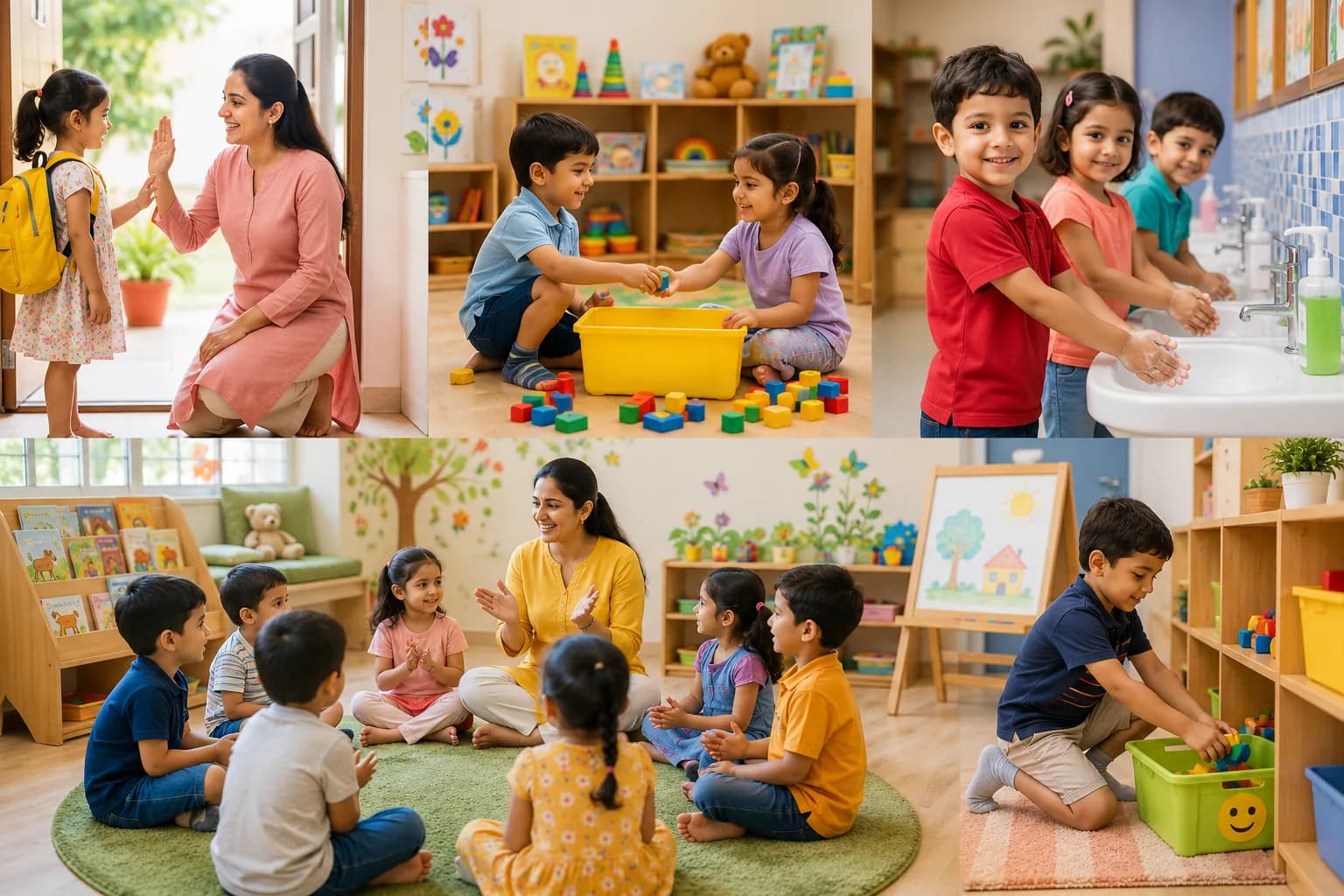
Joyful discipline helps preschool children build routines, boundaries, manners, sharing, self-control, and school readiness with warmth and consistency.
What is joyful discipline in preschool years?
Joyful discipline is not about scolding, fear, punishment, or forcing children to behave perfectly. In the preschool years, joyful discipline means helping young children understand routines, boundaries, manners, waiting, sharing, clean-up habits, emotional regulation, and group behavior through warmth, repetition, and calm guidance. At Kaizen Preschool in Nallagandla, discipline is seen as part of early childhood development. Children are gently guided to become confident, kind, responsible, and ready for group learning without losing the joy of childhood.
Discipline starts with predictability
Young children feel safer when they know what comes next. Predictable preschool routines reduce confusion and help children participate with confidence.
- A fixed arrival routine helps children settle into the preschool day calmly.
- Simple classroom routines such as greeting, circle time, snack time, handwashing, clean-up time, play time, and dispersal time help children understand order.
- When routines are repeated daily, children slowly learn what is expected without constant correction.
- Predictability supports emotional security, especially for toddlers, playgroup children, nursery children, PP1 children, and PP2 children.
- Preschool routines help children move from home comfort to school participation in a gentle way.
- Routine building for children also supports listening, independence, self-control, and school readiness habits.
Why routine matters for young children
A young child may not always understand long explanations, but they understand repeated patterns. When the day follows a familiar rhythm, children become calmer, more cooperative, and more independent. This is why preschool routines are an important part of positive discipline in early childhood.
Simple routines parents can use at home
Parents can support joyful discipline at home by creating simple routines for waking up, brushing, breakfast, packing the school bag, screen-free play, dinner, story time, and sleep. When home routines and school routines are similar, children feel more secure.
Boundaries can be warm
Clear expectations do not need harshness. Simple words, repeated reminders, teacher modeling, and calm follow-through help children learn.
- Warm boundaries teach children what is safe, kind, and acceptable.
- Instead of saying only no, adults can guide children with simple choices and clear words.
- Young children learn better when teachers and parents stay calm and consistent.
- Positive discipline preschool methods focus on teaching behavior, not shaming the child.
- A child who feels respected is more likely to listen, try again, and slowly build self-control.
- Gentle discipline for toddlers and preschoolers works best when adults are firm, calm, and loving at the same time.
Examples of warm boundaries
Instead of saying, 'Stop shouting,' an adult can say, 'Use your soft classroom voice.' Instead of saying, 'Do not throw toys,' the adult can say, 'Blocks are for building. Balls are for throwing outside.' This kind of language teaches children what to do next.
Firm does not mean harsh
Children need adults who are loving and firm at the same time. A warm voice, eye contact, simple words, and repeated guidance can help a child understand boundaries without fear.
Habits need repetition
Greetings, clean-up, handwashing, sitting in a group, waiting, and sharing become easier when they are practiced daily.
- Young child habits are built through daily practice, not one-time instruction.
- Children need many chances to repeat the same routine before it becomes natural.
- Clean-up time teaches responsibility and respect for shared classroom materials.
- Handwashing routines build hygiene awareness and independence.
- Group sitting, listening, waiting for a turn, and sharing help children become ready for school life.
- Preschool manners and routines grow slowly through modeling, repetition, encouragement, and patience.
Small habits create school readiness
School readiness is not only about letters and numbers. A child also needs to listen, wait, follow simple instructions, care for belongings, participate in group activities, and express needs with words. These habits grow slowly through repetition.
Praise the effort, not only the result
When a child tries to clean up, wait, share, or say sorry, adults should notice the effort. Simple encouragement like 'You tried again' or 'You waited for your turn' helps the child repeat the behavior.
Values are learned in moments
A story, a conflict over a toy, or a group activity can become a gentle opportunity to talk about kindness, respect, and responsibility.
- Preschool children learn values through real classroom moments.
- A small conflict can become a lesson in sharing, asking, waiting, and using words.
- Stories, rhymes, role play, and group activities make values easy for children to understand.
- Kindness, respect, responsibility, patience, and care are built through daily guidance.
- Joyful discipline helps children understand that their actions affect others.
- Teaching values through real moments makes child behavior guidance more natural and meaningful.
Turning conflict into learning
If two children want the same toy, the goal is not only to stop the conflict. The goal is to teach words such as 'Can I have a turn?', 'I am using it now', and 'You can have it after me.' These small moments build emotional and social skills.
Values through Indian-rooted learning
Children connect well with familiar stories, family examples, festivals, community helpers, and everyday Indian life. These simple contexts help children understand respect, gratitude, sharing, and responsibility in a natural way.
Parents and teachers should align
Children benefit when home and school use simple, consistent expectations around routines, language, and behavior.
- Home-school alignment makes joyful discipline easier for children.
- Parents and teachers should use similar simple words for routines, manners, waiting, sharing, and clean-up.
- When expectations change too much between home and school, young children may feel confused.
- Regular parent communication helps teachers understand the child better.
- Parents can support preschool routines by practicing independence and responsibility at home.
- Parent teacher alignment in preschool helps children receive consistent guidance across home and school.
Simple language works best
Children respond better to short and clear phrases such as 'walking feet', 'soft voice', 'hands to yourself', 'wait for your turn', 'use your words', and 'clean up together'. These phrases can be used both at school and at home.
Discipline is a partnership
Positive discipline is most effective when parents and teachers work together. If a child is learning to separate calmly, share toys, eat independently, or follow a bedtime routine, both home and school can gently support the same habit.
Common behavior challenges in preschool years
Many preschool behavior challenges are normal because young children are still learning language, self-control, patience, sharing, and emotional regulation.
- If a child does not listen, the adult can use short instructions, eye contact, and calm repetition.
- If a child grabs toys, the adult can teach simple words like 'Can I have a turn?' and 'I am using it now.'
- If a child refuses clean-up, the adult can make the routine predictable and do it together first.
- If a child shouts, the adult can model a soft voice instead of shouting back.
- If a child runs during group time, the adult can redirect with clear words like 'walking feet' and offer movement breaks.
- If a child cries during separation, a predictable goodbye routine can help the child feel secure.
- If a child struggles to share, repeated turn-taking games can slowly build patience and confidence.
Behavior is communication
In early childhood, behavior often tells us what the child cannot yet say clearly. A child may be tired, unsure, excited, hungry, overwhelmed, or seeking attention. Joyful discipline helps adults respond with guidance instead of anger.
Correction should teach the next step
The best correction tells the child what to do next. For example, instead of only saying 'Do not grab', the adult can say, 'Ask for a turn.' This supports positive discipline for preschoolers in a practical way.
Simple home routines that support joyful discipline
Parents can make discipline easier by using small daily routines at home. These routines support preschool habits, independence, emotional regulation, and school readiness.
- Morning routine: wake up, brush, get dressed, eat breakfast, and pack the school bag in the same order daily.
- Mealtime routine: sit in one place, use simple manners, try self-feeding, and clean up small spills with help.
- Clean-up routine: put toys back before moving to the next activity.
- Screen-time routine: set a clear start and stop time instead of sudden removal.
- Bedtime routine: bath, story, prayer or calm talk, lights dim, and sleep time.
- School bag routine: help the child place bottle, napkin, snack box, and school items in the bag.
Keep routines short and repeatable
A routine does not need to be complicated. Young children learn better when the same small steps are repeated every day with calm adult support.
Use the same words every day
Simple phrases like 'clean-up time', 'soft voice', 'walking feet', 'wait for your turn', and 'use your words' help children connect language with behavior.
What joyful discipline is not
It is important for parents to understand that joyful discipline does not mean allowing everything. It also does not mean controlling children through fear.
- Joyful discipline is not punishment-based discipline.
- It is not shouting, comparing, threatening, or labeling the child.
- It is not giving unlimited freedom without boundaries.
- It is not expecting preschool children to behave like older children.
- It is a balanced approach where love, routine, limits, and guidance work together.
- It protects childhood while slowly building self-control, responsibility, and confidence.
The goal is self-control over time
A preschool child will still cry, resist, grab, interrupt, run, or forget instructions. This is normal in early childhood. The goal of joyful discipline is to help the child slowly build self-control, language, confidence, and responsibility through repeated support.
How Kaizen Preschool supports joyful discipline
At Kaizen Preschool, joyful discipline is part of the daily classroom experience. Children are guided through routine, play, stories, movement, conversation, values, and teacher support.
- Children learn through play with purpose, not random activity.
- Teachers use caring guidance, simple instructions, and repeated classroom routines.
- Children are encouraged to express feelings and needs through words.
- Daily routines support independence, hygiene, responsibility, listening, and participation.
- The preschool environment supports school readiness without pressure-heavy learning.
- Children are guided with warmth, structure, repetition, and age-appropriate expectations.
A warm start for children near Nallagandla
For parents looking for a preschool in Nallagandla, Serilingampalle, Tellapur, Gopanpally, or Lingampally, it is helpful to observe how the school handles routines, transitions, clean-up, sharing, group time, and child behavior. These small daily practices show how discipline is actually built in a preschool environment.
Joyful discipline builds confident children
Joyful discipline helps young children feel safe, loved, and guided. It teaches them that routines are helpful, boundaries are caring, and good habits are built one small step at a time. In the preschool years, discipline should protect childhood, not pressure it. With warmth, repetition, parent partnership, and caring teacher guidance, children can grow into confident, kind, responsible, and school-ready learners.
FAQs
Common parent questions
What is joyful discipline for young children?
Joyful discipline is a warm and consistent way of helping young children learn routines, boundaries, manners, responsibility, and self-control without fear, shouting, or harsh punishment.
Is joyful discipline the same as positive discipline?
Joyful discipline is closely related to positive discipline. Both focus on guiding children with respect, clear expectations, repetition, encouragement, and calm adult support.
Why are preschool routines important?
Preschool routines help children feel safe and confident because they know what comes next. Routines also support independence, listening, hygiene, clean-up habits, group participation, and school readiness.
How can parents practice joyful discipline at home?
Parents can use simple routines, short instructions, calm reminders, limited choices, praise for effort, and consistent follow-through. Bedtime, mealtime, screen time, clean-up, and school preparation are good places to start.
How does Kaizen Preschool use discipline in the classroom?
Kaizen Preschool uses joyful discipline through predictable routines, caring teacher guidance, clean-up habits, group time, sharing, stories, play-based learning, and simple positive language.
Is discipline needed for toddlers and preschoolers?
Yes, but discipline for toddlers and preschoolers should be gentle, age-appropriate, and routine-based. Young children need repeated guidance, not harsh correction.
How do I discipline my preschool child without shouting?
Use short instructions, calm repetition, clear routines, limited choices, and warm follow-through. Preschool children learn better when adults guide them firmly without fear or shouting.
What should I do if my preschool child does not listen?
Go close to the child, make eye contact, use the child's name, give one simple instruction, and repeat calmly. Long explanations usually do not work well for young children.
How do I teach my child to share?
Start with turn-taking games, use simple words like 'my turn' and 'your turn', praise small efforts, and avoid forcing instant sharing. Sharing develops slowly with practice.
How do I build a daily routine for my child?
Choose a few fixed steps for morning, meals, play, clean-up, screen time, and bedtime. Keep the order same every day so the child knows what comes next.
What preschool habits should parents teach at home?
Useful preschool habits include greeting, handwashing, self-feeding, cleaning up toys, waiting for a turn, using polite words, carrying a school bag, and following simple instructions.
How does routine help child behavior?
Routine reduces confusion and gives children emotional security. When children know what comes next, they are more likely to cooperate and feel confident.
What should I look for in a preschool near Nallagandla?
Parents can observe how the preschool manages routines, teacher-child interaction, safety, sharing, clean-up, communication, child comfort, and classroom guidance. These show how children are supported every day.
Next steps
Helpful next steps
Continue with these related pages before booking a school visit or admission conversation.
Want to discuss your child's next step?
Book a school visit, call, or WhatsApp Kaizen Preschool to understand programs, daycare, admissions, and readiness support in Nallagandla.